


Bank of the Year: UBS
Finishing touches
UBS added the strengths of Credit Suisse to its own, making inroads into the technology sector and gaining an unparalleled regional footprint in capital markets. It reopened multiple markets across Asia and won roles on the region’s biggest, most impressive deals, making it IFR Asia’s Bank of the Year.
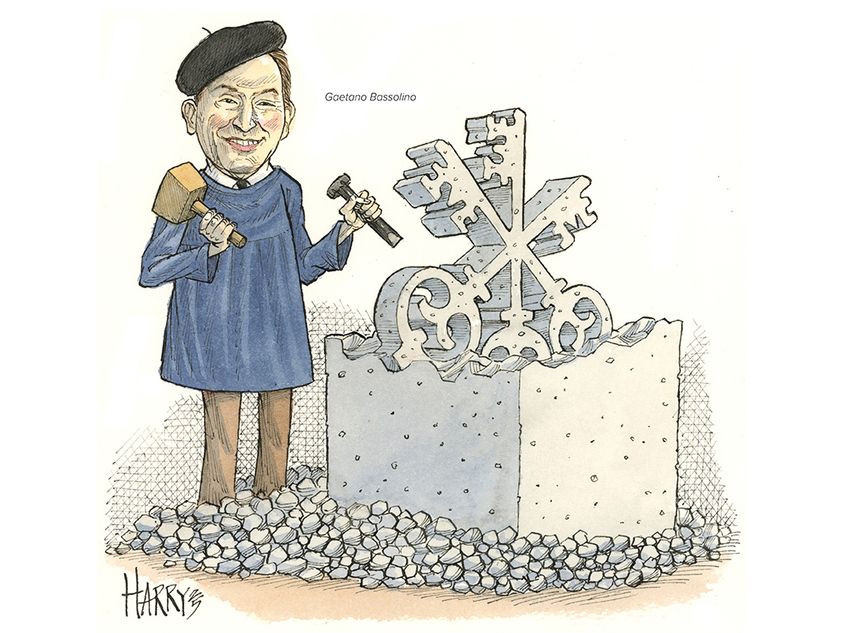
This was the year everything came together for UBS.
A merger with Credit Suisse, initiated in 2023, offered the opportunity to strengthen UBS’s coverage, but it was by no means certain to be successful.
The integration completed last year saw UBS refocus and become a major force in multiple asset classes, industries and geographies across Asia.
“We have been strengthening everywhere, but in some markets there has been a step change,” said Gaetano Bassolino, co-head of global banking for Asia Pacific with Greg Peirce.
“People have integrated incredibly well. We powered through the merger and came out stronger than before.”
UBS grew its market share in Asian equity and equity-linked capital markets by an impressive 200bp compared to a year earlier, to 6.4% or US$13.9bn of volume in the awards period, according to LSEG data.
In the G3 bond market, the bank’s market share rose 30bp to 3.3%, with US$9.4bn of volume.
That was reflected in deal income. UBS earned US$493.9m of investment banking fees from Asia Pacific ex-Japan, up 70.4% from the same period a year earlier, according to LSEG data, and grew its share of wallet to 2.4% from 1.7%.
“This is probably the best performance we have ever had,” said Bassolino. “There’s no question that there are some markets where we have a pretty dominant position.”
That has come from combining the best parts of Credit Suisse with the existing strengths of UBS.
Notably, UBS is now a mainstay on deals for some blue chip names like tech giant Alibaba Group Holding, previously a Credit Suisse client, and its expertise in the equity-linked business paid off in an extremely active year for convertible bond issuance.
“Historically, in China we were more tilted to FIG and real estate, but this year you have seen us on more tech deals,” said Bassolino.
The merger means that UBS, which already had a broad geographical footprint, is now well represented in virtually every market.
That includes India, where UBS closed its global banking office in 2021 to serve clients from Singapore instead. In 2023 UBS brought across Credit Suisse India’s 25-member investment banking, coverage and financing origination team and obtained an Indian banking licence last year.
The results are already on display, with UBS landing roles on the Rs125bn (US$1.44bn) IPO of HDB Financial Services, one of India’s biggest floats this year, and the listing of solar module maker Vikram Solar.
India was not the only market where UBS had to rebuild its presence in recent years. In March 2019 Hong Kong’s Securities and Futures Commission fined UBS HK$375m (US$48m) and banned it from taking sponsor roles in IPOs until January the following year, as a result of due diligence lapses in three previous floats.
That was a distant memory this year, as UBS landed sponsor roles on Hong Kong IPOs for the likes of tea chain Mixue Group and maternity care company Saint Bella.
It also won top-line roles in the year’s biggest equity transactions in the region, like electric vehicle maker BYD’s HK$43.5bn follow-on offering and Contemporary Amperex Technology’s HK$41bn follow-on. In addition it helped bring Alibaba’s US$3.2bn convertible bond, the biggest equity-linked transaction from Asia this year.
Given geopolitical tensions, corporate issuers have seen the benefits of adding UBS to their syndicates, especially as some of the biggest equity and bond deals were Reg S-only trades.
“Some syndicates used to be all US banks, but now you are seeing us get more top-line roles than ever before,” said Lauro Baja, head of global capital markets for Asia Pacific.
Regional reach
As well as delivering the largest equity raisings in Hong Kong, it worked on the year’s biggest IPOs in Singapore, Malaysia, Thailand and the Philippines.
The IPOs of NTT DCC REIT in Singapore, Eco-Shop Marketing in Malaysia, Mr DIY Holding Thailand, and Maynilad Water Services in the Philippines – the latter the region’s first green-labelled float – were all market-opening transactions.
In Australasia, it delivered a successful float for Virgin Australia Holdings, the final step of the airline’s rehabilitation after restructuring, and worked on a A$1.85bn (US$1.2bn) underwritten share placement by New Zealand software company Xero to fund an overseas acquisition.
As Singapore’s equity market rebounded, UBS helped bring a secondary listing from Nasdaq-listed software services provider AvePoint, raising S$259m from a follow-on. This was the first listing from Temasek-backed 65 Equity Partners, which invests in companies with the aim of listing them on the Singapore Exchange, and its success paved the way for others to follow.
UBS provided certainty to vendors with its block trade execution in uncertain markets.
It was sole bookrunner when South Korea’s SK Group sold D3.36trn (US$127m) of shares in conglomerate Masan Group, the only sizable block trade in Vietnam this year. It was also the sole bookrunner for a M$1.19bn (US$283m) clean-up trade in Malaysia’s IHH Healthcare, a W580.8bn (US$427m) clean-up trade in South Korea’s Shinhan Financial Group, and simultaneous blocks in SM Investment Corp and SM Prime Holdings in the Philippines.
“Block trades have been the backbone of our business,” said Baja. “In past transactions where we were not on the IPO or had a junior role, we were now asked to take lead roles when there was a block trade.”
These included a block in Hong Kong-listed Horizon Robotics, which had not picked UBS for its IPO last year.
In a huge year for equity-linked issuance in Asia, UBS won a 9.8% market share, according to LSEG data, and led deals for the likes of China Pacific Insurance (Group) and video platform Bilibili, as well as an Alibaba exchangeable bond into Alibaba Health Information Technology.
As well as volume, UBS brought structuring expertise. Miniso’s CB was accompanied by a call spread overlay, and Chow Tai Fook Jewellery’s by a concurrent share repurchase
“Equity-linked was one of our brightest spots this year,” said Aaron Oh, co-head of equity capital markets for Asia Pacific with Ivy Hu. “Our strength in the Reg S-only market and our innovation in things like call spreads and buybacks was recognised with leading roles on some of the biggest transactions.”
Bold in bonds
UBS does not have the same elevated risk appetite in the bond market that Credit Suisse did, preferring to focus mainly on investment-grade issues, but its capabilities were rewarded with high-profile deals from around the region.
It won top-line roles for the likes of Airport Authority Hong Kong, Korea Development Bank, the Philippine sovereign and Singapore’s Clifford Capital. In a rare hat trick, all three major Singaporean banks hired it to lead offshore bond deals.
“Despite record low credit spreads we continued to see incredible liquidity,” said Terry Schmassmann, co-head of debt capital markets for Asia Pacific with Peter Chang. “There was a strong return of the corporate hybrid product this year.”
UBS was a global coordinator for MTR Corporation’s US$3bn debut hybrid trade, having held the same role on its earlier senior deal. It brought a new structure for Hong Kong property company Hysan Development’s US$750m subordinated perpetual non-call 5.5-year issue, helping it to earn an investment-grade rating and appeal to a broad pool of investors.
In the high-yield sector it still delivered deals like Greentown China Holdings’ US$350m three-year non-call two issue in February, which reopened the market for Chinese property bonds after two years without any new issuance. It also brought Macau casino operator Melco Resorts Finance and aluminium producer China Hongqiao Group to the offshore market.
UBS was selective with its balance sheet, but in Australia it supported KKR in a crucial A$1.52bn (US$973m) leveraged financing for business software company MYOB.
Its strengths in M&A advisory encouraged clients to pick UBS for a range of capital markets transactions. In the Philippines, for instance, it was sole adviser to Metro Pacific Investments Corporation on its US$510m sale of a 50% stake in Philippine Coastal Storage & Pipeline in March, and then helped bring the Maynilad IPO for MPIC in October.
In the private market it was financial adviser to Yinson Production Offshore Holdings, a unit of Malaysia’s Yinson Holdings, as it raised US$1bn of redeemable convertible preference shares, with an option to upsize the deal by a further US$500m. The deal brought in top-tier investors like Abu Dhabi Investment Authority ahead of a future IPO.
The merger of UBS and Credit Suisse also formed a world-beating private bank, creating opportunities for deal origination and distribution.
“Wealth management is an enabler for us – especially when combined with our strong investment banking business model,” said Bassolino.
NTT DC REIT’s float was the first Singapore IPO in which UBS’s wealth management business came in as a cornerstone investor, showing the growing importance of that investor base.
Now that UBS has demonstrated its all-round strengths in practically every market in Asia, it is going to be tough to beat.
“There are banks with a bigger balance sheet, but no one has the same reach we do,” said Bassolino.
To see the digital version of this report, please click here
To purchase printed copies or a PDF, please email shahid.hamid@lseg.com