


Asian Bank of the Year: DBS Group Holdings
Directing flows
As Singapore’s market-revival efforts breathed life into dealmaking again, one bank was more than ready to capture opportunities from onshore and offshore issuers. For its impeccable timing, preparedness, and anticipation of changing market dynamics, DBS is IFR Asia’s Asian Bank of the Year.
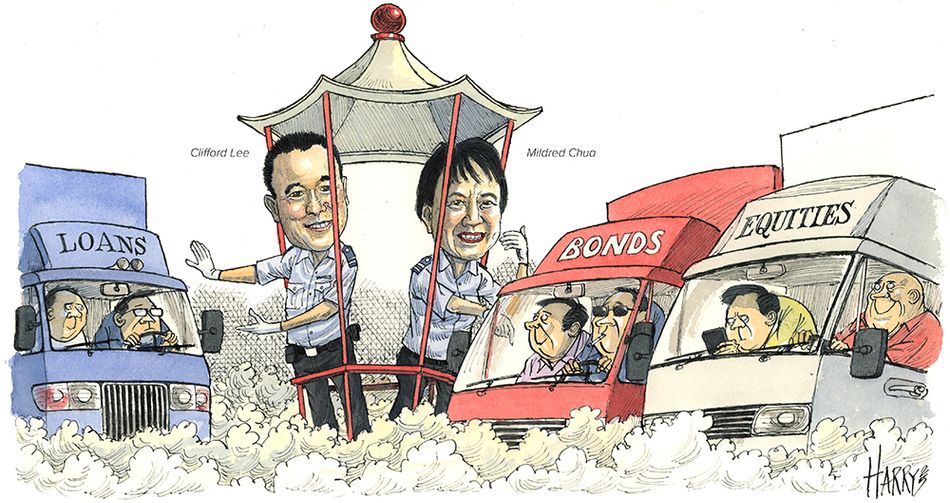
DBS Group Holdings’ robust pan-Asian platform and a collaborative view of its equity and debt capital markets franchises allowed it to capture capital markets opportunities this year, including a rebound in its home market.
Long-standing chief executive Piyush Gupta handed over the baton to Tan Su Shan in March, in a smooth, well-planned succession that saw the group’s market capitalisation jump to S$153.7bn (US$118.6bn) this year, surpassing US$100bn for the first time.
This gave it a solid base to seize opportunities as measures by a Monetary Authority of Singapore review group to revitalise the Singapore stock market through incentives for fund managers and issuers began to pay off, while it was ready for a pickup in bond issuance too.
The bank in 2024 merged its equity capital markets, brokerage and digital exchange operations with its treasury markets business into a unit that is overseen by bond industry veteran Clifford Lee as the global head of investment banking.
Approaching ECM and DCM as two sides of the same coin has allowed the bank to propose a range of financing solutions to clients more seamlessly at time when market conditions are extremely changeable.
“Companies need to fund business growth, and we want to assure them of that funding, regardless of the product,” Lee said.
“Some of the debt deals you are seeing, they were looking at equity, some of the equity deals were looking at debt. But depending on the timing, their ambitions, the objectives, the costing – we can now engage them quite quickly with the capital solution most optimal for their specific situation and give them confidence,” he said.
DBS has moved to retrain and cross-license bankers across origination, execution and syndicate to make them more versatile and ensure it has the resources to respond to changing market trends.
“Last year, when equity markets were quiet, we took the opportunity to retrain and help our bankers obtain dual licensing to move across equity into debt. This year it’s the reverse,” Lee said.
The bank’s investment banking fee income climbed 52% to US$205.5m in the awards period from January 1 to November 7, the highest since 2021, according to LSEG data.
In line with Singapore’s stock market revival, DBS’s biggest improvement came in equity capital market transactions. Fees from ECM deals surged more than 600% to US$34.6m during the review period, also the highest since 2021. In debt capital markets its fee income grew 26%.
Priming the pump
DBS was instrumental in opening the Singapore equity market in 2025, bringing out high-quality follow-on deals to attract investors, even though market conditions were mixed.
In April, DBS helped Frasers Centrepoint Trust raise S$220m through an upsized share placement in a deal that drew a strong reception. On the heels of that came CapitaLand Ascendas Real Estate Investment Trust’s S$500m share placement in May.
The response showed that investors were ready to jump back in, giving DBS confidence that it was time to reopen Singapore’s IPO market.
In July DBS helped bring NTT DC REIT’s US$773m IPO in what was the country’s largest listing in four years. Books were oversubscribed with demand from long-only institutions, hedge funds, real estate specialists and private banking clients, and even sovereign wealth fund GIC making its first cornerstone investment in a local float.
“We have seen global and regional institutional investors increasing their participation in Singapore IPOs. These investors want to build exposure through quality listings here,” said Art Karoonyavanich, global head of ECM at DBS. “We see investors who were previously dipping their toes into it now starting to grow.”
Shortly after NTT, CapitaLand Integrated Commercial Trust’s upsized S$600m new share placement saw strong participation across the board, including from private wealth and multi-strategy investors.
DBS then helped bring Singapore’s second-largest float of the year, Centurion Accommodation Real Estate Investment Trust’s S$771m IPO. Most of the REIT portfolio comprises worker accommodation, a new asset class for capital markets, but the deal was well received, with the institutional placement tranche subscribed 16 times and the retail offer 30.9x.
Diversification play
In the debt capital market, international investors showed appetite to diversify away from the US dollar, and DBS stood out for its ability to deliver deals to meet that demand.
DBS helped make US data centre provider Equinix’s debut Singapore green bond a success in March. Singapore-based investors looking to branch out beyond real estate plays lapped up the S$500m issuance.
The firm made a swift return just five months later, this time with a S$650m green bond issue.
“We are able to reach out to investors who are not traditional Singapore dollar investors,” Lee said. “Real money accounts are coming in for big numbers, and Singapore dollar supply is coming up with bigger deal sizes to accommodate broader participation.”
It also brought Prudential and Swiss Re to the Singapore dollar market to raise subordinated notes at advantageous terms, while feeding local investors’ appetite for yield.
“Introducing new names to Asia requires timing, education – we have done that for European banks, some US issuers and we are used to that drill,” Lee said. “Our value-add is as a gateway in and out of Asia. To make ourselves more relevant to the market we have to develop that market.”
In the US dollar market it brought a US$1bn deal for State Power Investment Corp as well as offshore Tier 2 deals for the likes of Saudi National Bank and Riyad Bank, connecting capital flows between Asia and the Middle East.
Besides the Singapore dollar and US dollar franchises, the bank’s strong offshore renminbi and Hong Kong dollar franchises position it well for investors navigating a fragmented world.
DBS recognises that as the diversification theme continues to play out and China’s drive to internationalise the renminbi ramps up, investors are keen to take exposure to the currency through high-quality names.
It helped Switzerland’s Nestle make its Dim Sum debut, followed by a jumbo Rmb10bn Dim Sum from State Grid Corporation of China, the largest offshore renminbi deal from a central state-owned enterprise, then brought Singaporean state investment company Temasek Holdings back for a Rmb5.5bn (US$777m) three-part bond that attracted orders of Rmb52.9bn.
DBS’s fee income from debt capital markets ticked up 3.4% to US$47.9m, according to LSEG data.
The other side of the investment banking business is syndicated loans, headed by Mildred Chua, group head of syndication and loan solutions.
Its strengths were recognised with a lead role on India’s largest syndicated loan of the year, US$2.5bn and ¥67.6bn (US$430m) facilities for Reliance Industries, acting as global coordinator, mandated lead arranger and bookrunner.
The deal attracted one of the biggest bank groups for an Asian loan this year, as 44 banks joined in syndication.
“We want to be a bridge and connect the world to Asia. Our clients want to tap Asia’s deep and diverse liquidity pool,” said Chua.
Amid intense competition in the loan market this year, DBS’s fee income improved by 17% and its share of wallet rose to 5% from 4.4% a year earlier, according to LSEG data.
“We have stayed true to our core business, which is to support our clients. Overall loan volumes went down in Asia, but DBS’s loan volume went up,” said Kelvin Lim, managing director, syndication and loan solutions.
High US dollar borrowing costs meant some Asian companies turned to local currencies for their funding needs, an area where DBS was well positioned. Its jumbo deals showed just how much liquidity was available in those markets.
When Marina Bay Sands launched a S$12bn syndicated loan, DBS was among the four mandated lead arrangers and global coordinators of the multi-tranche borrowing that comprised a seven-year term loan, a 6.5-year revolving credit facility and a delayed draw term loan. The loan attracted 22 lenders in general syndication.
South-East Asia’s data centre boom continues to be a bright spot for loans in the region. DayOne Data Centers’ dual-tranche green loan of around US$3.46bn-equivalent for its Malaysian projects, comprising ringgit and US dollar tranches, drew a strong response from 22 lenders, with six Chinese banks taking US$450m combined of the US$790m that was sold down from a US$1.7bn term loan portion.
That also demonstrated DBS’s ESG financing abilities under a team headed by Shilpa Gulrajani, head of sustainable finance.
It helped Aster Chemicals & Energy bring a US$1bn debut sustainability-linked loan that will fund the rejuvenation of its plants and be measured against the reduction of greenhouse gas emissions.
Another highlight was YTL PowerSaraya’s S$500m transition loan to finance the development of YTL’s maiden greenfield 600MW hydrogen-ready power plant. This was the first transition finance deal to be aligned with the Singapore-Asia Taxonomy for Sustainable Finance and the Asia Pacific Loan Market Association’s green loan principles.
Further afield, it worked on Indonesia’s first social bond issue, a rupiah deal for Bank Rakyat Indonesia.
The breadth of its abilities allowed DBS to deliver a stellar year on all fronts.
To see the digital version of this report, please click here
To purchase printed copies or a PDF, please email shahid.hamid@lseg.com