


The Great Buyback Binge
There has been a stock repurchase boom across the US in 2011 as many companies flush with cash have decided that they would prefer to buy back their own stock at deflated prices rather than expand their operations in a bad economy. Some banks have been able to join the party. But not all.
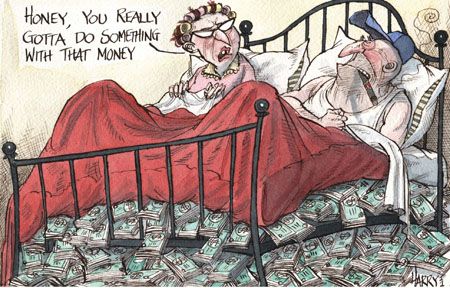
Corporate boards authorised US$390bn in stock repurchases in the year to the end of October. This was more than the full-year totals of 2008, 2009 and 2010. Given the historical data, 2011 will probably be the second-biggest year on record for authorised buybacks.
The 2008 credit crisis prompted many firms to hoard cash as the global meltdown unfolded. Many companies simply cut costs, increased their efficiencies and hunkered down. As a result, the amount of cash on US corporate balance sheets is in excess of US$2trn.
Despite their cash piles, companies remain reluctant to acquire other firms or spend capital to increase their scale. Quite simply, they are hesitant to take risk during a period when the US economy remains weak and the picture in Europe bleak. Many just want to sit tight until the haze clears.
But that money is clearly burning a hole in CFOs’ pockets and, conscious that their cash is earning almost nothing, they are wondering how best to deploy it. Active balance sheet management is the answer many have arrived at.
“Authorising a buyback offers companies the most flexibility,” said Rob Leiphart, an analyst at Birinyi Associates, since they continue to retain control of their assets. “If you use your capital to hire new employees it becomes a big negative if you have to cut jobs.”
Furthermore, if a company raises its dividend, often there is an expectation that it will be maintained at the higher level. When it is cut back it is often viewed by the market as a negative.
Meanwhile, Leiphart said, if a company authorises, say, US$500m in open-market buybacks and only does US$100m and stops – no one really notices.
The 2011 stock repurchase binge has provided investment banks with the ability to generate some modest revenue. This much-needed business came at a time when the IPO and secondary ECM market seized up.
“The share repurchase teams had been among the busiest teams in equity capital markets this summer during the height of market volatility,” said Mary Ann Deignan, head of equity capital markets for the Americas at Bank of America Merrill Lynch.
No big benefit for banks
But the increase in share repurchases is not going to make the banks rich. The banks tend to earn two to three cents per share when a company buys back its stock on the open market. It is a business where big volumes are needed for banks to make any significant revenue.
This year several companies have authorised very large buy-back programmes – Berkshire Hathaway, IBM, Pfizer, BlackRock, JP Morgan and Coca-Cola were among the most notable.
Most companies that authorise share repurchases go through with them. “The general rule of thumb is that for all the share repurchases authorised by US companies each year, roughly 80% of that total are ultimately executed,” said Robert Leonard, managing director in Citigroup’s special equity transactions group.
Most firms repurchase their stock on the open market over a period of time, providing them with the flexibility to buy their stock at a price of their choosing and a time of their liking.
But there are some corporate boards that want to reduce the amount of their outstanding stock immediately – without moving the market through a big transaction. They can do this through an accelerated share repurchase programme. The corporation protects itself by being able to buy back the stock within a certain price range as the bank offloads the shares over time, using derivatives.
For example, CVS Caremark bought back US$1bn of its own stock on August 24 through an accelerated share repurchase. It executed a deal with Barclays Capital where it agreed to lock in a maximum and minimum stock price while the bank offloaded it over a given time-frame.
In May, Northrop Grumman executed a US$1bn ASR through Goldman Sachs in which it bought back 15.6m shares, 5% of the outstanding, at an initial price of US$64.17 a share. If Goldman repurchased the shares below US$64.17, it agreed to pay Northrop Grumman; at higher prices, Northrop Grumman would pay Goldman in either cash or stock to settle.
“Accelerated share buybacks are a small part of overall share repurchases,” Deignan said, since “they provide less flexibility with respect to timing and execution than open market repurchases”. However, most agree, they are a generating greater interest.
Banks that aid issuers in this business are also able to earn fees from derivatives as well as trading revenue. Goldman Sachs, Morgan Stanley, BofA Merrill and Barclays Capital are viewed as leaders in the ASR business.
However, the decision to buy back stock, whether in the open market or through an ASR, often sends mixed signals to the market depending on the company type. Investors in high-tech companies, which are viewed as high-growth firms, get worried when a corporation begins to buy back its stock beyond what it issues to staff.
“It’s a sign that a company lacks confidence, and that they view owning their own stock as a better bet than acquiring other companies or expanding,” said Henry Schacht, chief executive of Schacht Value Investors. “With high-tech companies, this is not a good sign. In the tech industry, we have noticed that about 50% of buybacks are used to offset stock options.”
Furthermore, many experts doubt whether companies always buy back their stock at the best time. “Companies seldom consistently pick the right time to buy back their shares at advantageous prices,” according to McKinsey’s October report entitled: “The savvy executive’s guide to buying back shares”.
For example, Netflix bought its own stock at the wrong time. It bought back shares at a price above US$200 in the third quarter of 2011. Its stock was worth about US$90 on November 7.
“Companies seldom consistently pick the right time to buy back their shares at advantageous prices”
Another concern is that some companies buy back stock as a way to increase their earnings per share, since it lowers the share count. This can be used to make mediocre earnings numbers look better.
US banks blocked
While US banks have also tried to buy back stock, many have been blocked from doing so by the Federal Reserve. Several US banks have seen their stock prices take a beating this year, which is reflected in the KBW Bank Index down about 25% this year through November 7. Furthermore, these banks are struggling to grow, hesitant to acquire new business and are uncertain as to how tough financial regulations will be.
The Fed is taking a conservative approach to ensure that the large US banks meet Basel III capital requirements – especially those that will have to meet the extra surcharge to be levied on banks considered systemically important.
Stock repurchases reduce a bank’s equity base and Tier 1 common capital. Furthermore, equity is the purest form of acceptable regulatory capital.
Some banks, such as JP Morgan and Wells Fargo, implemented share buyback programmes earlier this year, after receiving the go-ahead from the Fed. JP Morgan announced a US$15bn multi-year programme, while Wells Fargo announced a US$200m (5.3bn in outstanding stock) share repurchase programme earlier this year.
Other notable banks, including BofA Merrill, did not get approval. In recent months it has only been the mid-sized banks and non-bank financials that have been active in buybacks, since they are not subject to the full brunt of Basel III. These companies have included Jefferies, BlackRock, Prudential Financial and Travelers.
