


Swiss Franc Bond House
Big is beautiful: One house consistently stood out in Swiss francs, maintaining its tight grip on a market it has long dominated despite increasingly intense competition. The biggest house in this unique market, with comfortably more deals than any of its competitors, Credit Suisse is IFR’s Swiss Franc Bond House of the Year.
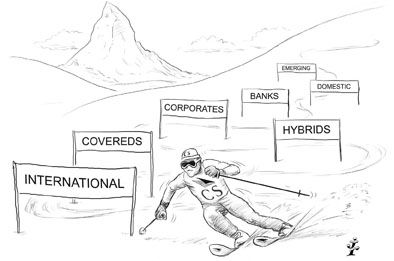
After a rollercoaster 2009 for the Swiss franc market, when it achieved record volumes, 2010 saw the pace of activity grind to a mere shuffle. Low rates and spreads left investors largely indifferent to investment-grade bonds. Credit markets were dominated by the unfolding European sovereign debt crisis, especially in the second half of the year. This had a negative impact both on investor demand and on basis swaps, which remained very expensive, suppressing international issuance.
Retail and private banking demand has traditionally driven market activity in Switzerland but in 2010 it all-but disappeared, leaving the few institutional investors that remained in the new issue market to dictate the agenda. Many transactions were therefore driven by a few lead orders, chased aggressively by several lead managers, draining liquidity and reducing average transaction sizes. A lack of retail demand undermined follow-on demand after the initial placement, making it more difficult for lead managers to take on primary positions.
According to Dominique Kunz, managing director of DCM at CS Zurich: “Trends were fleeting and often based on reverse enquiries from a handful of institutional investors, but one longer lasting theme was returning investor interest in financial institutions, particularly those based outside the eurozone.”
Financial paper made up 35% of 2010 issuance, against 19.6% in 2009, and in covered bonds it was 20% versus 10.6%. Australian banks alone accounted for 10% of total bank issuance.
From about mid-year, the competitive landscape sharpened significantly. The top houses strengthened their syndicate teams, as reduced liquidity led to the most fiercely competitive conditions seen in the market for years.
CS managing director of fixed income syndication and primary trading, Daniel Gut, said: “We were able to maintain our high league table position and our leadership in most market segments thanks to the unique set up of DCM operations in Switzerland and the superior resources devoted to this market: the only underwriter with a Zurich-based DCM team covering international issuers, the largest fixed income and credit research department and the most seasoned documentation team.”
CS maintained its number one position in the international segment league table for the 20th consecutive year, though its market share slipped to 39% from 42% in 2009, testament to the increasingly intense competition. It maintained nearly twice the market share of the second place lead manager.
It was also comfortably the top underwriter in the domestic segment, a league table position it has held ever since the segment’s inception. With a market share of more than 35%, it was 15% ahead of the second placed runner.
The extreme low interest rate environment drove investors – particularly agencies – into longer tenors to get some yield pick-up. To compensate for the volatile market conditions a new issue premium became necessary, and spreads widened again after the massive tightening of late 2009.
CS showed good agility in the volatile market environment. It found promising opportunities in the low yield/low spread environment, including a focus on the bank sector following the European stress tests in the summer. CS brought more non-self led transactions by banks to market than its competitors, from names such as HSBC, SG, ANZ, Westpac, NAB, Lloyds TSB and Bank of America Merrill Lynch. It launched the largest transaction of the year, for Lloyds, amounting to SFr800m in 4-1/2 years, and the two largest financial guaranteed issues, from Allied Irish Banks and Bank of Ireland.
Foresight
CS foresaw the return of the covered bond asset class and initiated supply with issues for CFF, DnB NOR Boligkreditt, Dexma, Statshypothek, Nordea Hypotek and Swedbank Hypotek, among others. It was involved as a lead in 56% of all covered bond issues in the year.
CS’s accomplishments in the corporate sector were even more pronounced for domestic names. It lead-managed transactions from Rieter, Arbonia Forster, Hero, Lonza, Georg Fischer, Holcim and others. It was involved in all benchmark utility transactions in 2010, including Axpo, KKW Linth-Limmern and KW Leibstadt.
CS’s expertise was not limited to the investment grade sector. It opened the market for sub-investment grade issuers with a SFr250m 2015 transaction for Rieter, unrated by the major agencies but with a CS internal rating of high BB. With better investor sentiment for corporate names, the market continued to see strong demand for high-yield names in the Swiss franc market.
On the back of the successful inaugural corporate hybrid transaction by Hero in 2009 – tapped in April 2010 – CS led a SFr325m perpetual non-call four transaction for domestic convenience food producer Aryzta in September. It was only the second corporate hybrid transaction ever in the Swiss franc market. The bank was also instrumental in opening the insurance hybrid market in November with Helvetia, quickly followed by Zurich Insurance.
Emerging markets also featured heavily in 2010. CS reopened the market for emerging market borrowers with a SFr150m transaction for Petroleos Mexicanos in February. One month later, Mexican telecoms provider America Movil came to the market with CS as sole bookrunner. Other notable EM transactions came from CABEI, CAF, CBQ, VTB Bank and Bank of Moscow.
After the sovereign crisis in May and June, CS reopened the Swiss franc market for Spanish issuers in June with a SFr150m transaction for Instituto de Credito Oficial.
In the international corporate segment CS brought the largest corporate deal to the market as joint lead manager for Glencore Finance Europe totalling SFr600m in 5-1/2 years. Other CS landmark transactions in the international segment included Aeroport de Paris with a massively oversubscribed seven-year; Municipality Finance; Akademiska Hus; the Triple A rated debut from the State of Lower Austria; Tokyo Electric Power Corp’s first appearance in three years; GE; the City of Vienna; HSBC France at least twice; EDF; the Province of Ontario, with a dual-tranche fixed and floating deal worth SFr500m; and a BMW UK Capital for SFr500m in five-years which attracted strong retail demand.
Active in FIG
Global Swiss reinsurance company Swiss Re came to the market with a dual tranche deal with CS as joint lead, covering all the investor bases. Triple A rated DnB NOR Boligkreditt launched the largest Scandinavian trade of the year with SFr650m in five-years, through CS as sole lead manager.
Bank of Ireland’s government guaranteed SFr325m benchmark issue offered a 3% coupon and a three-year maturity and was very well received by the market due to the attractive coupon, which primarily attracted the retail segment and private banks. The deal was increased a few days later to SFr425m.
That was followed by AIB’s SFr300m 2% government-guaranteed bond, coming with a one-year tenor and targeting AIB’s reinvestment flows. The issues reflected the strong demand for banks resulting from the stress tests and before the panic ensued following the turmoil in the Irish market.
Bank of America entered the market with a SFr250m 2016 issue as the first US financial in Swiss francs since 2007, with CS again acting as sole bookrunner. And at the top of the FIG totem pole, Triple A rated Rabobank entered the market with a longer dated 11-year SFr400m issue, which was very well received by investors, especially being the first Swiss franc fixed-rate benchmark of the year.
CS was present in the domestic market’s landmark transactions, not least IFR’s Swiss Franc Bond of the Year, Helvetia Insurance’s SFr300m hybrid, on which it was joint lead with Deutsche Bank. It brought a raft of unrated but well-known names to the market.
The success of Axpo Holding, a Swiss energy utility that saw impressive demand, encouraged its also unrated subsidiaries, Kraftwerke Linth-Limmern and Kerkraftwerk Leibstadt, to follow it to the market with dual-tranchers: SFr400m in seven and 12-years and SFr350m in six and nine-years, respectively. Valiant Bank completed its maturity profile in late March with a SFr300m 2015 transaction, and the Canton of Bern launched a 13-year in two hits.
Rieter Holding printed the first domestic Swiss franc sub-investment grade trade ever with a five-year 4.5% SFr250m bond, filling order books within 15 minutes. Georg Fischer came to the market with a six-year SFr200m bond issue; Arbonia Forster Holding, a supplier to the building industry, printed a SFr200m offering at 3.375%, seeing strong interest from retail investors; and Lonza, the Swiss life sciences company, raised SFr400m through a 3% six-year note issue. Baloise Holding successfully issued SFr300m of 10-year bonds, meeting with a positive reception and quickly growing from the initially announced size of SFr150m to price the double of the announced deal size.
Jon Penner

