


US High-Yield Bond House
Solid performance: The US high-yield market in 2011 was one of extreme highs and lows, yet one bank maintained its vigour throughout the year. For its consistent expertise and leadership and for providing solid deal execution on a wide array of new issues, Bank of America Merrill Lynch is IFR’s US High-Yield Bond House of the Year.
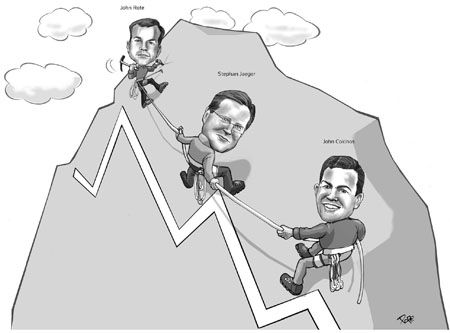
Bank of America Merrill Lynch dominated the US high-yield market in 2011, underwriting a variety of interesting and difficult transactions, providing solid execution for both issuers and investors, and topping the left-lead league tables.
From mid-November 2010 to mid-November 2011, the bank left-led 105 deals at more than US$50bn in volume for a top market share of 20.5%, according to the Thomson Reuters US league tables.
The year in high-yield was one of completely distinct halves. For the first half, deal volume broke records as opportunistic issuers took advantage of a very welcoming market to refinance as yields hit all-time lows. Investors piled into the asset class, lured by low default rates and relatively attractive returns in the low-yielding environment.
Indeed, May set a new global monthly volume record for high-yield debt when issuance hit US$51.875bn from 94 deals, according to Thomson Reuters data. The previous record was set in March, with US$46.677bn priced from 82 deals.
However, by June the market capitulated to broader economic worries, including eurozone default fears and US debt ceiling concerns. Some small new issue windows appeared in the summer, before the market nearly shut from August through the end of October, during which time just US$17.985bn priced globally from 35 deals.
Staying on top
In this environment, BofA Merrill maintained its dominance. Through the end of June, the bank had left-led 76 new deals, which represented 21.8% market share and topped the Thomson Reuters league table. From June through to mid-November the bank largely held on to its market share despite the volatility, pricing 13 deals for a market share of 20.1%.
Yet regardless of its sheer might in the league tables, the bank stood out as a top choice for first time and Triple C issuers as well as for jumbo deals, sponsor-led transactions and second-lien offerings.
Some of BofA Merrill’s more notable transactions included CIT’s US$2bn bond issue priced in March that repaid debt as part of its emergence from bankruptcy protection, CityCentre’s US$1.5bn two-part issue priced in January that was ultimately a big bet on the Las Vegas recovery, and a US$1bn bond for AES that partially funded the acquisition of DPL Inc, the parent of Dayton Power & Light Company.
BofA Merrill was active in the LBO space, underwriting bond deals for Epicor (BofA Merrill led the loan as well), SRA International and Del Monte Foods, among others. And the bank showed its creativity on offerings for Brigham Exploration Co, IASIS Healthcare and CityCenter, using innovative structures to address complicated situations.
For example, Brigham Exploration, an oil and gas firm, was looking for financing but was also considering being sold. The company needed a solution that would allow it to be sold without having to pay too much of a penalty when tendering for the bonds.
Pioneers
“We came up with a non-traditional change of control, whereby if the company was going to be acquired in the first 12 months they may redeem all of the bonds at 110 instead of 125,” said John Rote, head of US high-yield syndicate. “It saved them a lot of money and helped them gain financing just in case the sale process did not go through. But if it did, they were going to have a capital structure that would allow the sale process to go through at an attractive price.” The CoC feature was unique in the market and has since been replicated.
Among Triple C offerings, BofA Merrill priced deals for companies including Vanguard Health, Brigham Exploration, Epicor, inVentiv Health, SRA International, IASIS Healthcare Corp and Jeld-Wen among many others, which highlights its expertise doing difficult transactions.
“When you do a tough deal, investors want to make sure you’re going to trade it, that you’ve done the right diligence,” said John Cokinos, head of US leveraged finance capital markets. “It’s not just that you are going to sell it, but that you’re going to stand behind it and make markets in it. Being able to do all these deals is a testament to our strength.”
For first time issuers, BofA Merrill says it often uses non-deal roadshows to inform investors on the credit, a strategy that pays off for both the issuer and the buy-side. The US$225m senior unsecured deal for JM Huber Corp, a small private chemical company, was one such example. The credit was largely unknown to investors, but by doing a non-deal roadshow the leads were able to discuss the credit with the buy-side and ultimately price the Ba3/BB+ rated private for life deal with relatively aggressive covenants at 6.625% at par.
Other notable first-time issuers included Epicor, Examworks, SRA International, CityCenter Holdings, Jeld-Wen, Laredo Petroleum and Calumet Specialty Products, the last three of which were done in the latter part of the year even as the market backed up.
Failure is not an option
But Chrysler was perhaps BofA’s most notable deal in the high-yield space. On May 19 the company priced its increased US$3.2bn dual-tranche secured notes issue as part of a financing package that would allow it to repay all of its outstanding loans to the US government. The deal was one of the highest profile issues of the year, and failing was not an option. BofA Merrill and Goldman Sachs were joint physical books, with Citigroup and Morgan Stanley acting as joint bookrunners.
The deal was unique in several ways. For one, the second-lien structure assisted in gaining greater investor appetite. The deal also provided significant flexibility for the issuer, including no additional limitation on indebtedness and the ability to have certain covenants suspended upon reaching investment grade.
In addition, the deal structure allows the company to access up to US$3.5bn of Department of Energy financing to further its development of fuel-efficient vehicles and allows for the refinancing of the company’s existing US$4.7bn Voluntary Employee Beneficiary Association notes through issuance of unsecured debt.
As a result of the financing, Chrysler was able to repay all outstanding obligations to the government, totalling US$7.6bn, six years ahead of schedule.
“It did get a lot of profile within the US and Canadian governments. They actively followed the deal and, from a symbolic standpoint, the importance of the automotive industry to the broader economy gave it notoriety that we normally don’t see in leveraged finance,” said Michael Browne, co-head of leveraged finance origination.
“This was obviously a comprehensive, incredibly well co-ordinated overall leveraged financing execution which had a number of moving pieces, bonds obviously being a critical part of it,” said Stephan Jaeger, head of high-yield capital markets.
The US$3.2bn two-part senior secured second-lien bond issue was split into a US$1.5bn eight-year non-call four tranche and a US$1.7bn 10-year non-call five tranche. The eight-year piece priced at 8% at par, on the wide end of talk, while the 10-year priced 25bp wide of that, as expected.
Chrysler, along with BofA Merrill’s other highlighted transactions, clearly demonstrate the bank’s strong client relationships and its strength and expertise in the high-yield market.
To see the full digital edition of the IFR Americas Review of the Year, please click here.

