


US Loan House
A league of its own: JP Morgan is usually top of the US syndicated loan league tables, but the bank showed it was in a league of its own in 2011. For courageous choices, consistent intellectual leadership and proving itself as the premier shop for marquee borrowers, JP Morgan is IFR’s US Loan House of the Year.
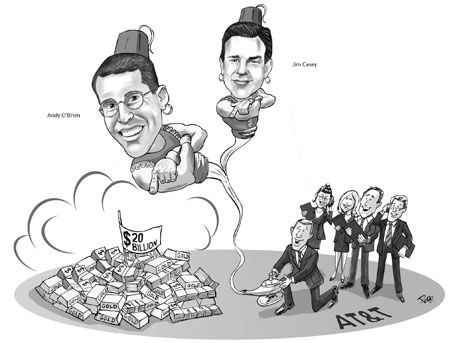
While global financial markets were buffeted by unprecedented volatility in 2011, the US high-grade loan market was an oasis of liquidity for corporate borrowers. Issuers turned to agent banks to improve terms on plain vanilla financings and refinancings of 364-day revolvers and multi-year transactions.
The loan market’s stability meant that these deals were consistently ready and available and presented few challenges to test originators’ imagination. It is in this environment that JP Morgan stood out from its peers with the courage of its convictions and leadership.
The bank led a significant number of regular corporate refinancings, but, more importantly, made headlines with administrative agent roles and fully underwritten commitments for large M&A bridge loans such as AT&T and United Technologies Corp, which few competitors could have matched.
“Every time there is a mission critical deal or complication, [boards] just feel more comfortable dealing with us,” said Jim Casey, co-head of global debt capital markets at JP Morgan.
“It’s [due to] our firm’s brand, reputation and the consistency of our team,” added Andy O’Brien, the bank’s other co-head of global DCM.
In the past year, JP Morgan’s corporate refinancings included names such as Wal-Mart Stores, The Depository Trust & Clearing Corp, Pfizer, Novartis Healthcare, Kraft Foods, American International Group and Merck.
Kicking out incumbents
In several situations this year, issuers, including Merck, Eli Lilly & Co, Kraft Foods, Cardinal Health, Novartis and Pfizer, chose JP Morgan as lead-left arranger/administrative agent over incumbent banks.
“These are world-class names [saying], ‘I’ve got to make the change over to JP. We want you to lead the deal, set the tone, we want you to tell the story’,” O’Brien said.
Casey added: “At the end of the day, if you’re CFO, your job is to get money at the lowest possible cost and you’ve got to make the determination about who you think is better suited to do that.”
Clients agree. “With JP Morgan, I don’t think we could have a better administrative agent than we have,” said one official at a lending relationship. “We always look at them for advice about what is happening in the market.”
“JP Morgan is the gorilla in the space,” another client said.
AT&T
Despite regulatory pushback that could yet derail the deal, it is impossible to discuss JP Morgan’s performance in 2011 without highlighting its involvement with US telecoms operator AT&T.
AT&T announced its bid to buy T-Mobile from Deutsche Telekom in a cash-and-stock transaction valued at about US$39bn on March 20, backed by a US$20bn bridge loan to help fund the US$25bn cash component of the deal.
When news emerged on March 21 of JP Morgan’s sole US$20bn underwriting commitment on the bridge loan backing the bid, many in the market were surprised. For some, such a large undertaking by a single bank was a courageous bet that few could have matched.
The 18-month pledge for a 364-day loan was the largest sole commitment any bank had ever made. JP Morgan bet the bank on the deal, which comprised 17% of the firm’s Tier 1 common equity at the end of 2010, according to Moody’s.
For others, it was a risky proposition that could have encouraged reckless behaviour. In a March 28 note, Moody’s suggested that such behaviour “may encourage more banks to take on greater single-risk exposure, which would be credit-negative for the industry”.
Tapping a single lender was part of AT&T’s strategy. Confidentiality is key to a successful M&A deal, especially with a US$39bn acquisition at stake, and AT&T reached out exclusively to JP Morgan to underwrite the transaction. This meant there were no other banks bidding for the deal, which was structured during a weekend with no leaks.
“When leaks occur the story gets told without [the company] having the chance to tell it,” said O’Brien. “That’s why confidentiality is so important.”
Only a few other global banks have the firepower to take on such a large transaction. JP Morgan has consistently been one of the top two investment-grade lenders in the US, according to Thomson Reuters data.
“We are in that unique place where we have the capital to make these commitments and we know where the market is, so having those together really makes us a powerhouse,” O’Brien said.
Casey added: “When folks move in and they want to buy these companies, they want to pay as little as possible. They don’t want anybody talking about it and that plays into our capabilities.”
JP Morgan’s syndication strategy was impressively fast. Despite the low-risk proposition that lending to the Single A rated wireless services provider entailed, US$20bn is a hefty sum that the bank could not retain. Discussions about syndicating the loan began on March 23, shortly after the US loan market was hit by the shockwaves that followed Japan’s catastrophic tsunami on March 11.
Three days after Moody’s critical note on March 28, JP Morgan had offloaded more than 90% of its exposure among 11 lenders in a swift syndication that allowed the bank to shrug off concern about its decision to go it alone on the underwrite.
“This is a good deal for JPM. Kudos for them,” a banker at a rival firm said at the time.
JP Morgan’s track record with AT&T spurred United Technologies Corp’s management to call the firm in September when it needed a US$15bn bridge loan to back the acquisition of aircraft components maker Goodrich Corp.
JP Morgan was the first bank to get the call. Other lead arrangers, Bank of America Merrill Lynch and HSBC, subsequently joined the deal.
Marquee deals
JP Morgan is building an impressive back-catalogue of large, marquee transactions. In December 2010, the bank agreed to provide a US$8.6bn unsecured bridge loan which construction equipment firm Caterpillar needed to buy equipment manufacturer Bucyrus International.
Caterpillar already made a wide range of mining equipment, but the company wanted to expand to meet demand from mining customers scrambling to take advantage of rebounding commodities prices. The US$8.6bn deal, which included US$1bn of Bucyrus debt, was the largest in the company’s history.
JP Morgan also acted as joint bookrunner in the US$6bn bridge loan that backed US chemical firm EI DuPont Nemours & Co’s acquisition of Danish industrial technology concern Danisco for US$6.3bn.
The transaction, which established DuPont as a leader in industrial biotechnology, was backed by a US$4bn unsecured bridge term loan and a US$2bn unsecured bridge term loan. JP Morgan was also M&A adviser.
JP Morgan was also one of the five lead underwriters that committed to the US$45bn bridge loan backing global mining concern BHP Billiton’s hostile bid for Canada’s PotashCorp last year which included a US$25bn 364-day bridge loan.
Although the acquisition fell through, the financing again showcased the bank’s ability to underwrite a huge deal at the drop of a hat. That deal used a group underwrite. But as the AT&T transaction showed, JP Morgan is willing to go it alone when required.
To see the full digital edition of the IFR Americas Review of the Year, please click here.

