


Bank for Financial Sponsors: Morgan Stanley
Fixing the roof
Private equity firms had a better time listing or selling their companies in 2025, although bumps along the way meant many also needed bespoke private deals. For its work on landmark transactions in all those areas, Morgan Stanley is IFR’s Bank of the Year for Financial Sponsors.
After two years when IPO markets were largely in hibernation, private equity firms were finally able to return to public listings for some of their marquee firms in 2025. But it was not as smooth or gung-ho a year as many financial sponsors had hoped for in January, and the shock of "liberation day" in April and other geopolitical bumps meant they had to stay nimble and sometimes look for alternative ways to monetise investments.
Activity picked up through the year, however, and financial sponsors were behind many of the year’s landmark deals in public and private markets – with the pipeline steadily filling through the year.
The IPO of Swedish home security firm Verisure, majority owned by Hellman & Friedman, built on the improving mood. It raised €3.59bn in October, making it the biggest IPO of the year globally, the largest ever IPO backed by a private equity firm and the biggest new listing in Sweden for 25 years.
That followed the sponsor-backed listings of insurance platform Accelerant and healthcare firm Hinge Health. And before them, a pair of follow-on deals for aerospace and defence firm StandardAero showed there was demand for the right deals in public equity markets.
Morgan Stanley had lead roles on all those transactions and also showed the way with bespoke deals in private markets, including for US insurers Hub International and Acrisure.
“After a long drought, we've seen the return of the sponsor-backed IPOs, and follow-on offers,” said Eric Hopp, co-head of financial sponsors for Morgan Stanley. “And the ancillary impact of having an IPO market that is functioning – albeit the bar is still relatively high – is it brings back the ability to run dual tracks.”
While that’s a double bonus for financial sponsors keen to exit portfolio companies, the road still had plenty of potholes, especially between April and June.
“The tariffs, and the question of what form they were going to come in, put a lot of questions around what you could market and how you would value stuff, hence why you had a lot of corporate and sponsor IPO situations get drawn out longer than a lot of people would have thought,” said Hopp, who runs the sponsors business globally with William Sanders.
Indeed, it wasn’t really until August that the IPO taps fully reopened, and much of the first half of the year was characterised by putting plans on hold or looking for alternative ways to cash in investments and boost distributions to paid-in capital.
“In the periods where the IPO markets during this past year were not quite open, we were creative and used that time to find other ways to return capital to sponsors,” said John Dickinson, head of sponsors for North America.
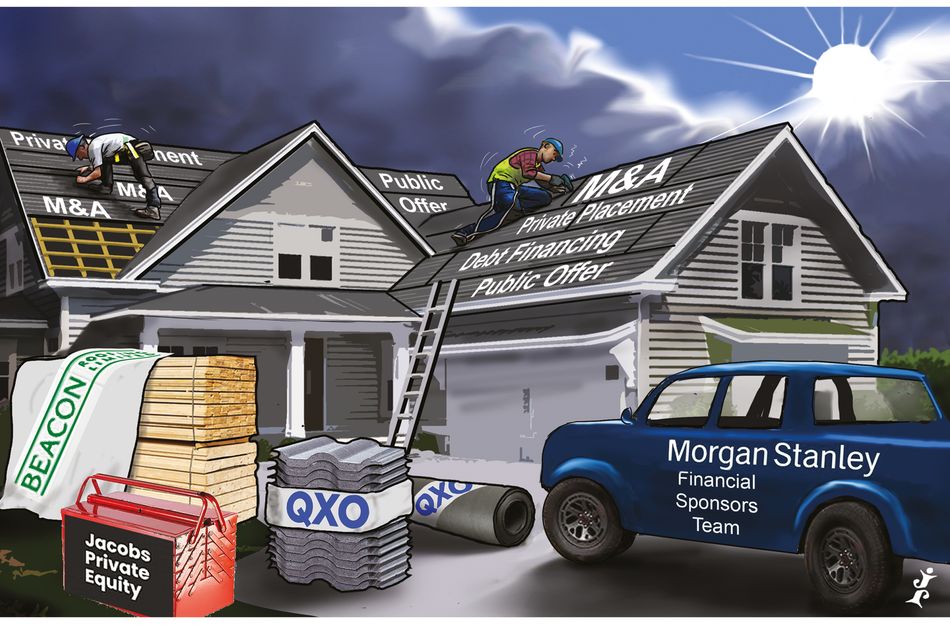
The bank also showed that it could be fleet of foot with a slew of deals for one company – US building materials firm QXO. Morgan Stanley has had a long relationship with the firm and serial entrepreneur Brad Jacobs, who is chairman and CEO of QXO and managing partner of Jacobs Private Equity.
Morgan Stanley was lead financial adviser to QXO on its US$11bn purchase of Beacon Roofing Supply in March, and the same month it was sole placement agent on an US$830m private placement. A month later it led a public offer to raise US$575m and helped the company raise US$4.5bn in debt markets.
“It's a case study of how we can bring everything to bear – advisory, private markets into a public company, common equity issuance, convertible issuance and traditional debt issuance for a large client of ours that Morgan Stanley has had a long relationship with,” said Michele Harris, executive director in the sponsors team in New York.
Very sure
Almost all of Verisure’s Stockholm fundraising was primary, with proceeds paying for the acquisition of ADT Mexico announced three months earlier. The deal secured significant cornerstone investors and shares were priced near the top of the indicated range and rose 22% in the month after the listing. Morgan Stanley was joint global coordinator and bookrunner alongside DNB Carnegie and Goldman Sachs.
Two weeks later, Hellman & Friedman followed up in the debt markets with a €1bn PIK toggle notes issue. H&F owned 43.7% of Verisure after the IPO and the PIK notes were secured against that holding. Morgan Stanley was joint global coordinator on that deal too.
Either side of "liberation day", the bank was lead-left on the US$1.4bn listing of SailPoint in February for Thoma Bravo, the biggest US software IPO in nearly four years, and on the US$724m listing in July of Accelerant for Altamont Capital Partners, which helped reopen the market.
Other notable sponsor-backed listings the bank worked on included Neptune Flood and Firefly Aerospace in the US, LG CNS in South Korea, Geekplus Technology in Hong Kong and Dr Agarwal’s Health Care in India.
A pair of equity follow-ons also reinforced the case that IPOs are just the start of an exit, and listing a minority stake and coming back to sell more later can be a better option than a full sale.
That was the case for StandardAero, majority owned by The Carlyle Group, which listed in October 2024. Morgan Stanley worked on that IPO and was joint lead bookrunning manager and stabilisation agent for a follow-on deal in March that raised US$1bn, and another one in May to raise US$840m.
“It really validated their thesis of not taking the proverbial bird in the hand in the fall of 2024 when they had some pretty big, full sale offers,” said Hopp. “They said: ‘we believe in management; we believe in the tailwinds of business; we believe in how the business is being run; we think that valuation can increase.’ And it did.”
Private dancer
Another serial client has been Hub International, also backed by H&F, and Morgan Stanley followed its work on the firm’s “private IPO” in September 2023 by leading another private deal in May. Hub pulled in a US$1.6bn equity investment from T Rowe Price, Alpha Wave Global, Temasek and others in a fundraising that valued the firm at US$29bn, more than in 2023.
Morgan Stanley was also exclusive placement agent on a bespoke private deal for Acrisure in May that raised US$2.1bn from new convertible senior preferred stock, which valued the firm at US$32bn.
The need to innovate and adapt also extended to debt financings, where the surge in private credit has widened and shifted the options available for sponsors.
That was shown with a two-step financing for Clearlake Capital’s US$7.7bn purchase of Dun & Bradstreet in August. Morgan Stanley was financial adviser to Clearlake and then joint lead arranger on US$5.5bn of private credit financing to replace a bridge facility, which tapped both private and syndicated lenders.
In the M&A arena, in addition to the big QXO and Dun & Bradstreet transactions, the bank advised on multibillion-dollar deals for Clearlake when it bought a majority of ModMed, on TJC’s sale of Silvus Technologies to Motorola, and for Thoma Bravo on its purchase of software firm Olo.
It was also lead financial adviser to KKR in March when it sold Seiyu, one of Japan’s biggest supermarket chains.
Zen space
The asset management industry continues to evolve and Morgan Stanley changed its structure at the start of the year to combine the team in financial sponsors that covered alternative asset managers and the team from the financial institutions group that covered traditional asset managers.
The unified team, led by Hopp, is significant because asset managers touch on multiple areas of the bank beyond investment banking, including sales and trading and the wealth division.
So too will EquityZen, a platform that Morgan Stanley bought in October that provides trading in private companies. “This acquisition fits right into that ecosystem, into that food chain,” said sponsors co-head Sanders. “It’s another tool in the toolbox.”