


Bank for Financial Institutions: Morgan Stanley
Conjuring deals
For its work across changing landscapes for banking, insurance, asset management and fintech – advising on multibillion-dollar M&A deals, equity and debt financing, and bespoke private placements – Morgan Stanley is IFR’s Bank for Financial Institutions.
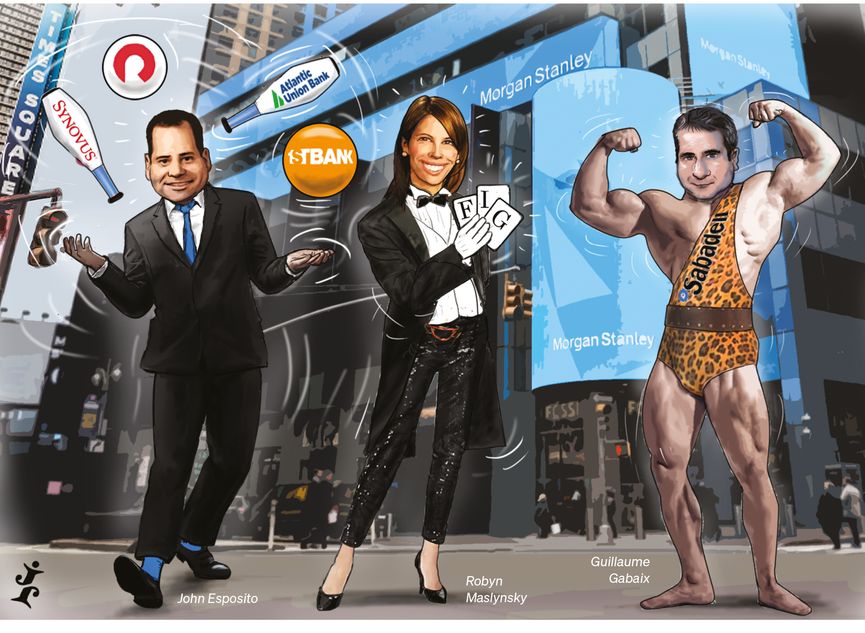
Adapting to changing regulations and financial market wobbles has always been a prerequisite for advisers on bank deals, and that was more apparent than ever in 2025 as US regulators started fast-tracking regional takeovers while European authorities were putting up roadblocks – all while a global tariff fight threatened to disrupt deals and upend timing.
In contrast, not much got in the way of buoyant insurance and asset management activity as the two industries converged, a process that saw a surge in domestic and crossborder blockbuster deals as incumbents tried to future-proof and smaller fast-growing firms continued to snap at their heels.
Across all those areas, Morgan Stanley led on many of the landmark transactions: it advised Synovus on its US$8.6bn takeover of Pinnacle and a slew of other US regional deals; it advised Spain’s Sabadell on its successful takeover defence against BBVA and the sale of its UK arm; it dominated the insurance landscape with M&A, debt and equity raises, private placements and IPOs; and it led a handful of bumper outbound partnerships by Japanese firms.
Many of the mandates were repeat work for longstanding clients, including its role as financial adviser to US insurer AssuredPartners on its US$13.5bn sale to Gallagher. Morgan Stanley also led the equity and debt raise for the buyer to fund the deal.
“There’s a theme here of repeat business, and the element of consistently coming back and doing the next deal for the same clients, in addition to expanding the pie,” said Robyn Maslynsky, head of financial institutions for North America who runs the insurance services team. “We're also proud that we did both sides of the [AssuredPartners] deal ... we sold the business, and then we led the financing.”
Getting together
Global fees from financial institution deals from January to November 7 were US$31.9bn, up 10% on 2024 and the highest since 2021, according to LSEG data. FIG accounted for 27% of all investment banking fees.
Fees from bank deals rose 18% from a year earlier to US$7.6bn, and Morgan Stanley advised on many of the deals across US regional banks, where the arrival of a new administration sparked consolidation.
Morgan Stanley was lead financial adviser to Atlanta, Georgia-based Synovus on its move in July for Pinnacle and two months later advised Denver-based First Bank on its US$4.1bn sale to PNC. It also advised Rocket Companies on its purchase of Redfin; Guild Mortgage on its sale to Bayview Asset Management; and on First Financial Bank’s purchase of BankFinancial.
“The shortening of the regulatory approval process is leading to a lot of this regional bank consolidation,” said John Esposito, co-head of the global financial institutions group. “Now that transactions get approved in less than three months, the large buyers are willing to do a transaction and then be ready to do another one almost immediately.”
As the market heated up, regional players were in need of more than just M&A advice. Morgan Stanley supplemented its role as sole financial adviser to Atlantic Union Bank on its US$1.3bn purchase of Sandy Spring in April, leading an equity raise and sale of commercial real estate loans.
“We're finding more and more that our loan solutions effort is getting integrated into our investment banking M&A dialogue to bring holistic solutions to clients in the regional bank space. If they want to buy a bank, but don't like how much commercial real estate exposure they have, can we help them think how to exit that as part of the transaction? And that's been the biggest change,” Esposito said.
In Europe, the regulatory landscape has been far more mixed, and unclear.
“The rules of engagement have changed throughout the year. We've moved from a spirit of openness to – in many countries, if not most countries – barriers being established,” said Guillaume Gabaix, co-head of FIG. The third global co-head is Gavin McFarland.
The hardest-fought tussle saw Spain’s Sabadell fight off a €14bn takeover approach from BBVA, which ended in October after an 18-month hostile approach. Morgan Stanley was defence adviser to Sabadell and advised it on the sale of its UK bank TSB in July to Santander for £2.9bn, a key part of its defence.
Morgan Stanley was also financial adviser to Discover on its sale to Capital One in May for US$35.3bn.
And it advised Hong Kong’s Hang Seng Bank on the deal that made it fully part of HSBC, when the latter bought the 37% it did not already own for US$13.6bn. A possible purchase had been rumoured for decades but conditions had never aligned; even when they did, the transaction was far from a formality.
“It looks from afar like internal restructuring but there were some really intense negotiations. It's public that we actually raised the price three times before we settled on a deal,” said Song Yang Lee, head of FIG for Asia Pacific.
Japanese shoppers
Morgan Stanley has about 150 people in its FIG team, comprising about 70 in North America, more than 40 in Europe and about 35 in Asia Pacific, including 15 in Japan. But the FIG team says that is multiplied by its ability to tap into other parts of the bank, including the financial sponsors team and across investment banking, sales and trading, wealth management and other coverage bankers, such as in technology.
That collaboration was showcased in a flurry of outbound deals from Japan, as big firms regained an appetite for expansion in the US and Europe and called on Morgan Stanley, the top Western bank in Japan, where it has a joint venture with MUFG.
The bank was exclusive adviser to Sompo on a US$3.5bn partnership with US insurer Aspen, to Meiji Yasuda on its US$2.3bn partnership with Legal & General in the US, and to Dai-ichi Life on a partnership and minority stake purchase in the UK’s M&G. It also advised Nissay on the purchase of its remaining stake in Resolution Life for US$8.2bn.
Its crossborder abilities were also tested as exclusive adviser to Macquarie on the sale of its asset management public investments business in North America to Nomura for US$1.8bn – less than three weeks after "liberation day". That resulted in protections being added for both buyer and seller in case markets significantly deteriorated – or improved.
Fintech chimes
Another rapidly evolving landscape was in fintech, as growth companies added scale and profitability, and Morgan Stanley again tapped the benefit of repeat work. It was sole financial adviser to private equity firm GTCR on the sale in April of Worldpay to Global Payments for US$24bn, one of more than 10 transactions for GTCR in the past five years.
In August it advised LPL Financial on the US$2.7bn purchase of US wealth manager Commonwealth, and led on all related financing on the deal: bridge finance, an equity raise and debt.
The bank advised on a batch of fintech IPOs, including for Chime, Gemini and the US$1.37bn listing of Klarna.
And after combining its asset management coverage to include its FIG bankers who covered traditional asset managers and the team from financial sponsors who covered alternative managers into one, Morgan Stanley led on more than US$40bn of deals in the sector in 2025. They included BlackRock’s US$12bn bet on private credit with the acquisition of HPS; Kline Hill Partners’ sale of a minority investment to TA Associates; and Coller Capital’s strategic minority investment from State Street.
Other insurance deals included lead-left roles on the IPOs of Accelerant and Neptune Flood, and leading bespoke private placements of US$1.6bn for Hub International and US$2.1bn Acrisure, which valued the firms at US$29bn and US$32bn, respectively. They were the latest in several deals for each firm.
And it was lead financial adviser to Baloise on its SFr18bn (US$22.4bn) merger with Helvetia in April to create Switzerland’s second-biggest insurer – and which, like Hub, went through during the tariff announcement turbulence.