


M&A Adviser: Goldman Sachs
Pennies from heaven
When M&A markets boom, Goldman Sachs finds another gear. Competitors edge closer to the long-standing leader in quieter times but when there are deals in every industry, in every market and at nearly every size, no one compares. Goldman Sachs is IFR’s M&A Adviser of the Year.
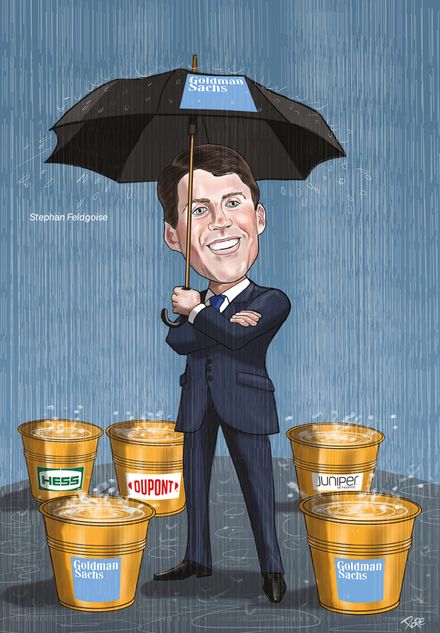
The year may have started slowly for M&A bankers, but by the end of the second quarter it seemed like deals were falling from the sky. Not paltry deals either – massive, industry-defining deals were being announced most Mondays and, more often than not, Goldman Sachs was on one side of a transaction or the other.
“In my career I did not think we would look back and see a period as active as we saw in 2021,” said Stephan Feldgoise, global head of M&A at Goldman Sachs, in a recent briefing to clients. The volume of announced deals in the four months from August to November have rivalled the levels of 2021, the best year ever for M&A.
At Goldman, the period was topped off by the announced sale of Nasdaq-listed Electronic Arts for US$55bn to an investment consortium of Saudi wealth fund PIF, Silver Lake and Affinity Partners. The all-cash deal is the largest leveraged buyout ever as Saudi Arabia seeks to take a leading role in computer gaming and e-sports. Goldman was sole adviser to EA.
“It was mind-blowing and makes you wonder what else might be possible,” said Ben Wallace, Goldman's co-head of M&A in the Americas.
And yet the year did not have the best start. A quiet first quarter gave way to a near shutdown after US president Donald Trump announced his tariff policy on "liberation day" in early April. However, after a short period of reflection, the market moved rapidly out of the doldrums and has since seen almost nonstop activity.
For 2025 through to the early part of November, Goldman advised on US$1.4trn of new transactions, up from US$819m at the same point a year earlier – an impressive 73% increase, outstripping the overall market. “We're very proud of that,” said David Dubner, the bank's global head of M&A structuring.
“We've advised on 291 deals ... greater than US$500m, which is the barometer we focus on,” Dubner said. “That's the second highest ever that we've had in a year-to-date period.”
Goldman’s share of deals, at 23%, is the highest ever at that point in a year. Not only does Goldman have the highest share of deals, it also has the biggest lead over rivals, Dubner said.
For completed deals in the period, the figures are even more impressive. For the year to November 7, the IFR Awards period in 2025, Goldman worked on 357 deals with a combined value of US$911bn, giving it a 33% share of the total value of completed deals in the period, according to LSEG data, at US$2.76trn. Nearest competitor JP Morgan’s share was 23%, at US$636bn from its 306 transactions.
Goldman was the only bank in the top five most active advisers by deal volume to increase its market share compared with the same period a year earlier, meaning it has stretched its lead over competitors in an active M&A market, seeing overall volume rise by 24%.
Dream deals
Across the market, the number of transactions with a value of more than US$10bn in 2025 doubled from 2024. And 20 of the completed deals that Goldman advised on had values of more than US$10bn.
Helping Goldman keep its edge in a booming market is its M&A centre of excellence comprising roughly 80 bankers across six verticals: M&A structuring, activism defence, M&A quants, sponsor M&A, continuation vehicles and M&A capital market, which focuses on how shareholders trade M&A transactions.
“The name of the game from our standpoint is dream deals,” Dubner said. “And transformational M&A feels alive and well, and very much in the focus of C-suites and boards that we engage with, as they think about scale, industry disruption and consolidation.”
Among the biggest deals to close in 2025 was Chevron’s US$52.3bn all-stock acquisition of rival Hess, which Goldman advised on. The combined company has one of the most differentiated portfolios in the oil and gas sector, with leading positions in critical energy markets around the world.
Hess’s sale took more than 20 months to complete after major competitor ExxonMobil intervened to say it had right of first refusal to take full control of the joint interests it had with Hess in assets off the coast of Guyana. That went through a lengthy arbitration process but did not derail the deal’s completion.
Another major sale mandate in the sensitive commodities and materials sector saw the bank advise US Steel on its sale to Nippon Steel, another transaction that took more than a year and a half to execute. The complicated US$14.8bn crossborder transaction drew fire from two US presidents – Democrat Joe Biden and Republican Donald Trump.
Both presidents vowed to block the deal on national security grounds during a highly contentious election in 2024. Ultimately, the cash sale secured approval from Trump, who essentially became counterparty to the transaction with the power to dictate terms. He insisted on the US retaining a “golden share” in the business, allowing it to block subsequent sales – an American first.
Trusted technicians
Goldman was also active across the technology sector. As well as the sale of Electronic Arts to the PIF consortium, the bank was sole adviser to Juniper Networks on its US$14.3bn sale to Hewlett Packard Enterprise, which looked to make the most of Juniper’s capabilities in artificial intelligence.
The transaction faced scrutiny from regulatory authorities led by the US Department of Justice. It necessitated some divestments by HPE as well as offering some access to third parties to some of Juniper’s technology to alleviate the DOJ’s concerns about potential lack of competition in this growing area.
Elsewhere in the AI world, Goldman had another important mandate advising OpenAI, the company behind ChatGPT, as it negotiated a US$40bn funding round from SoftBank Group and other investors, giving the private AI company a US$300bn valuation.
Goldman advised software investment firm Thoma Bravo as it bought Boeing’s digital aviation solutions business, including Jeppesen, ForeFlight, AerData and OzRunways for US$10.55bn in an all-cash transaction.
The bank was also active in the financial sponsors’ realm. It advised Sycamore Partners on its nearly US$24bn acquisition of Walgreens Boots Alliance, part of a wider reorganisation of Italian dealmaker Stefano Pessina’s health-linked retail empire.
Another company with roots in Europe, UK independent schools operator Nord Anglia Education was one of the largest businesses to be taken private in 2025. Goldman advised the target on the US$14.5bn secondary buyout by a consortium led by Canada Pension Plan Investments, EQT, Neuberger Berman, CF Alba and Dubai Holding.
Spinouts remained a key element of Goldman’s business. A notable transaction was the US$20.3bn separation of DuPont’s electronics business Qnity.
Future prospects
Goldman is expecting the strength to hold in the M&A cycle. “We've seen a very constructive backdrop for M&A,” Dubner said, citing fiscal policy, with taxes in the US coming down, easing monetary policy and a more favourable regulatory backdrop. “It’s all becoming more supportive of M&A transactions.”
There is also a substantial level of dry powder, or cash reserves, at private equity firms and sovereign wealth funds that is capable of keeping deal levels elevated. “We think that we're in the second year of a five-year run,” he said of the current M&A cycle.