


Sustainable Finance House and Americas Sustainable Finance House: BNP Paribas
Diving deep into the blue
Reflecting its sustainable finance leadership across regions and instruments, especially its role in the year’s sovereign ESG and European Green Bond landmarks, and its notable progress in blue and other nature-related transactions, BNP Paribas is IFR’s Sustainable Finance House and Americas Sustainable Finance House of the Year.
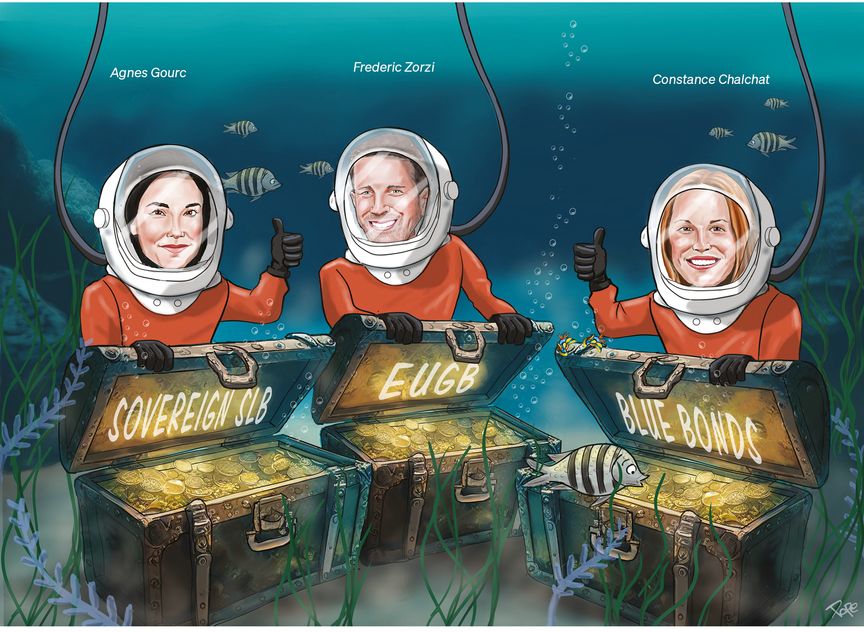
Despite the year’s macroeconomic and geopolitical challenges for ESG, “we've been able to continue ... pushing for green, pushing for sustainable, ensuring that we would deliver on development finance”, said Constance Chalchat, BNP Paribas' chief sustainability officer for global markets.
“We are firmly committed. We continue pushing the boundaries, evolving to scale the market, develop new segments and really address clients’ journeys.”
Frederic Zorzi, global head of primary markets, puts it another way: “We strongly disagree with people who say ESG doesn't exist or is not important.”
BNPP merged its ESG financing advisory and structuring efforts during the year in which the bank topped the sector’s global league tables across overall ESG bonds, green bonds and sustainability-linked bonds for the third year in succession.
“For us, being number one is not an objective – it's a result,” said Zorzi.
The bank emphasises going beyond conventional bookrunner roles. “In the vast majority of the deals where we are a bookrunner, there is an active engagement from our team with issuers and investors,” said Agnes Gourc, co-head of sustainable capital markets solutions, giving examples of framework structuring, updating and providing advice on investor engagement and ESG ratings.
BNPP said its focus is on fundamentals. “We are not always going for the spectacular or the big headline. Building the foundation of the product is key,” said Zorzi, who points to spending more than six months on a €30m private placement “because we believe it's important and senior management believes it's important, and this is the way to pave the market”.
Sovereign success
Sovereigns were notably warm in their assessment of BNPP’s contribution to their ESG issues during the year. Marjan Divjak, director general of the treasury directorate at Slovenia’s finance ministry, called the bank “instrumental” in developing its sustainability-linked financing framework and handling its subsequent inaugural €1bn sustainability-linked bond – the first by a European sovereign and IFR’s Sustainable Bond of the Year.
BNPP was ESG structuring agent on the deal.
Divjak described the pair as “working in close partnership to ensure a structure that incorporated Slovenia’s decarbonisation plans and was considered best in class by investors".
Similarly, Denmark "valued the strong collaboration” with BNPP on the first sovereign bond under the European Union's new Green Bond Standard, according to Helle Eis, principal treasury manager at Danmarks Nationalbank, which manages the sovereign’s borrowing. BNPP was sustainability co-coordinator on the DKr7bn (US$1.1bn) deal in September.
BNPP was also bookrunner for sovereign green benchmark deals in euros for France and Italy, as well as repeatedly for Austria in Swiss francs.
In the new EuGB format, which Gourc termed “that leading element [to] keep the market evolving”, BNPP reported an overall 15% market share that put it 3.5 percentage points ahead of its nearest rival. Besides Denmark, its assignments took in all the first corporate, public sector, financial institution and supranational EuGBs.
These were for A2A as joint bookrunner, Ile de France Mobilites as ESG structuring co-adviser, ABN AMRO as sustainability co-coordinator and the European Investment Bank as joint lead manager, respectively.
The bank also attracted more than 250 market participants to webinars on the new statutory instrument, having begun hosting workshops with the European Commission and regulators in 2024.
Blue emphasis
In a year where ESG markets’ focus on nature topics grew significantly, BNPP stressed blue financing of ocean and freshwater projects, plus drinking and wastewater.
The bank’s blue output – which saw it achieve a goal for the year of €1bn in funding for the “maritime ecological transition” and add coastal and marine conservation and restoration as eligible uses of proceeds under its own green bond framework – included its parent’s first three private placements under the label, totalling US$87m.
It also arranged a €75m structured note for the group linked to the MSCI Euro Blue Select and World Water Enablers Decrement 5% Index. Targeted to individual buyers, the deal involves a donation to water-related scientific and social foundations.
In addition, BNPP was global coordinator on a very rare blue benchmark offering for water management company Saur with its €500m bond.
It also arranged a US$30m blue certificate of deposit for a Singaporean bank.
“We managed to establish the fact that blue can be a standalone colour and not only a shade of green,” said Chalchat, adding that the firm holds a pipeline of “blue-specific” mandates. “We really showed that this can be done and there is investor interest.”
This effort formed part of what she called a “big, big push on nature” during the year. After exceeding its €4bn 2024 target by as much as a third for funding businesses that protect terrestrial and marine biodiversity, BNPP was involved in a “practitioner’s guide” on ESG bonds for nature that the International Capital Market Association published in June. This aims to scale up bond financing that supports biodiversity and natural capital.
It also published an “ocean position paper” to coincide with June’s United Nations Ocean Conference in Nice, France.
“Nature requires a pragmatic approach when it comes to directing capital towards impactful projects,” said Chalchat.
The bank’s 2025 deals with biodiversity use of proceeds include Italy’s green government bonds. These labelled BTPs allocate up to 20% to sustainable land use and protection, as well as protection and restoration of terrestrial and marine biodiversity and ecosystems.
Others included euro and Swiss franc green bonds for Swedbank and Severn Trent, respectively.
Americas acceleration
The nature theme was an important dimension of BNPP’s progress in the Americas during the year, with two of its blue transactions placed for Latin American multilateral development banks. In May it was blue coordinator and lead manager on a €30m inaugural blue bond for the Central American Bank for Economic Integration that finances a “sustainable recovery programme” for Lake Yojoa, the largest in Honduras.
The following month it arranged a €100m blue bond for Development Bank of Latin America and the Caribbean (CAF) – to finance ecosystem protection and adaptation in Brazil and Ecuador. The UN Development Programme was a technical adviser on the deal, which BNPP’s Cardif insurance arm bought.
CAF lauded BNPP’s support, which also covered the development lender’s first sustainable finance framework, its €1.5bn inaugural sustainability bond and it becoming the first Latin American/Caribbean institution elected to the executive committee of ICMA’s sustainable finance principles.
The bank “consistently provided top-tier advice, insightful feedback and extensive knowledge sharing", said Manuel Valdez, capital markets and derivatives director at CAF.
BNPP was also blue bond coordinator on a SFr100m (US$125m) five-year for Banco del Estado de Chile.
Other highlights in the region include roles as structuring co-adviser for Snam’s US$2bn SLB, the first to incorporate net-zero emissions targets across Scopes 1, 2 and 3, and as bookrunner for RWE’s US$1bn green bond.
Overall, BNPP stood out as one of the region’s strongest league table performers over the year. It rose to seventh place for ESG bonds in the Americas, according to LSEG data, and was less than US$200m behind third place, compared with 13th a year earlier.
Moreover, it ranked first in Latin America, the data show. Its bookrunner assignments included a €1.7bn social bond for Chile; US$1.5bn and £750m sustainability bonds for Cabei; and US$700m for Brazil’s Caixa Economica Federal that marked the Americas’ first public social inclusion bond.