


Leveraged Finance House and North America Leveraged Finance House: JP Morgan
Bigger and better
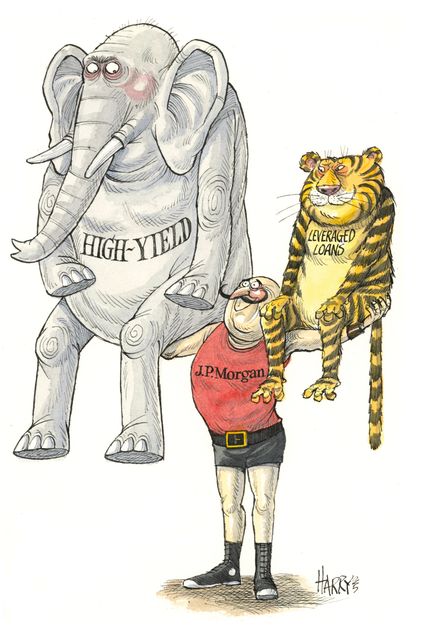
JP Morgan is a powerhouse across debt markets. And that was particularly so in the world of leveraged loans and high-yield bonds, where the bank led the vast majority of the mega financings in 2025. For shepherding the asset class’s most important and complex deals, JP Morgan is IFR’s Leveraged Finance House and North America Leveraged Finance House of the Year.
When JP Morgan stumped up a US$20bn loan to back the US$55bn buyout of video game maker Electronic Arts, it marked a watershed moment for the leveraged finance market but also topped another blockbuster year for a US bank that consistently sits atop league table rankings.
The EA deal is the largest leveraged buyout in history and the biggest committed LBO financing on record. The transaction also underscored JP Morgan’s willingness to support the right clients in a big way in a year when US tariff policies shook market confidence.
Few banks have that kind of firepower, nor the market intelligence to know when, and when not, to make such a large commitment – and at such speed. The EA loan was underwritten over the course of just a couple of weeks.
“One of the things we did really well was to combine our origination, research and credit strengths, and that allowed us to be nimble and aggressive when others might have been a little more nervous,” said Brian Tramontozzi, head of North American leveraged finance capital markets at JP Morgan.
JP Morgan has rightfully earned a reputation for its perceptive market reads and staying above the fray during a crisis. It was one of the few big banks that scaled back ahead of the last buyout frenzy and as a result was largely left unscathed by the hung loan saga that plagued so many of its peers.
That track record results from extensive due diligence on each and every credit, but also good market intelligence. The sheer volume of deals led by JP Morgan means the bank is in constant contact with the buyside, helping it garner information on inflows into the asset class and cash positions so that it can better time debt sales.
“We own our risk,” said Tramontozzi. “If we can’t get comfortable lending to these companies two or three years out, whether or not we think we can sell the term loan or high-yield now, we’re going to say no to those deals.”
The EA loan, which has already been syndicated to other banks, is expected to be sold into the broader loan and bond market in early 2026. But it is just one example of how JP Morgan has skilfully managed risk while also keeping its top spot in the league tables in 2025.
Running big deals
Indeed, the bank backed other big financings in 2025, most notably for private equity firm 3G Capital’s US$9.4bn buyout of casual footwear company Skechers.
JP Morgan led the US$6bn-plus syndication of bonds and loans in both the euro and US dollar markets in June when tariff concerns still hung over the market. This was particularly relevant to Skechers, which imported much of what went into its products from Asia.
“There was a lot of diligence work around the company’s ability to move production between different countries in Asia. We analysed literally the cost per item of production under different tariff regimes,” said Tramontozzi.
“We made a judgment call on whether we could sell that through the market if the worst-case scenario occurred.”
Skechers’ ability to move production to other parts of Asia helped lessen potential tariff costs and comforted the buyside, but investors also liked a sponsor that was seen as a strong operator of its businesses.
“The confidence we knew [3G] would instil for the buyside went a lot into that [analysis] as well,” said Todd Rothman, a managing director in leveraged finance capital markets at JP Morgan.
That faith in 3G’s business acumen helped diminish some of the perceived risks, allowing JP Morgan to drop a senior secured bond in US dollars to create a more favourable capital structure for the issuer after garnering a hefty order book.
And in what was an unusual move for an LBO, the bank was able to fund US$2.2bn of the buyout through a PIK toggle bond, which despite its risks drew considerable demand among yield-hungry investors on the hunt for new money options.
Smaller trades
Yet it is not just big balance sheet deals that have kept JP Morgan ahead of the pack and able to grow its leveraged finance business. Debt sales for big-cap companies may capture headlines and bolster league table positions but competition for such business is fierce and often results in razor-thin fees.
Smaller middle-market companies have been just as important at JP Morgan, which has invested heavily in an area where fewer banks vie for attention and often offers better economics.
“Big tier-one private equity firms don’t just do US$20bn deals. They have mid-market strategies and smaller cap names,” said Rothman. “We have [hired] in our mid-cap banking space over the course of the past year because we know that’s a very big growth engine.”
The bank led debt sales for credits of all stripes. These included cruise ship operator Carnival, arms manufacturer Czechoslovak Group, data centre operator CoreWeave, utility Hawaiian Electric Company and Qnity, the electronics unit spun off from DuPont – to name a few.
The bank also did not shy away from trickier trades such as a challenging refinancing for the Triple C rated American Bath, the Centerbridge-owned manufacturer of showers and bathtubs.
It also helped troubled pharmaceutical firm Bausch Health, rated Caa2/B–/CCC, gain much-needed breathing space in March when it refinanced billions of US dollars of looming maturities in a US$7.4bn debt deal that at the time included the biggest single US junk bond since 2021.
Bridging markets
JP Morgan also played a key role in bridging the US and European markets on a number of landmark trades during the year.
The bank handled the upsized US$3.25bn-equivalent seven-year term loan B that formed the body of the US$4.5bn-equivalent debt package funding the buyout of The Boots Group, the international business of Walgreens Boots Alliance.
The debt sale successfully tapped not just the UK and European audience but also unlocked significant US demand for a UK retail and pharmacy name.
JP Morgan was lead-left bookrunner for the €1.075bn, £375m and US$1.5bn TLBs, with that portion of the transaction increased by US$1bn at the expense of a US dollar bond and some preference shares.
Another complex major cross-currency transaction saw JP Morgan take the lead-left bookrunner role on the euro bond leg of the more than US$7bn debt sale for ION.
ION’s debt sale formed a central plank of a reorganisation to bring together three subsidiaries – ION Markets, ION Corporates and ION Analytics – under one of the largest capital structures in Europe, the ION Platform.
The concept was to create a single software, financial data and intelligence company, with a more simplified capital structure, to reduce reporting volumes, improve debt liquidity and result in fewer capital market transactions.
The euro high-yield offering comprised a €600m seven-year non-call three offering and a €500m five-year non-call two issue at yields of 6.875% and 6.50%, respectively, inside initial price thoughts of low 7s and high 6s.
JP Morgan again helped an issuer tap different pools of liquidity, as a lead-left bookrunner on US$900m TLB and a physical bookrunner on the €975m TLB for the £1.5bn-equivalent deal that supported the buyout of UK precision instruments maker Spectris.
KKR finally won shareholder approval and clinched Spectris in August, beating rival Advent in a bidding war. Preparation for the deal had started in July by readying engagement with rating agencies, with an extensive premarketing exercise seeing the book already covered two times over before the deal entered the public market.