


Euro Bond House: BNP Paribas
Ticking all the boxes
Every market has its themes; the challenge for banks is being able to address them. The euro bond sector is no different and can sometimes seem more complex, given its diverse geographical makeup. But BNP Paribas is a past master in successfully navigating its way around a territory where it feels very much at home and is IFR’s Euro Bond House of the Year.
In a year in which the euro market reached new heights in terms of what it could deliver, BNP Paribas was always going to have something of an advantage, given its prowess in the currency’s bond arena.
And so it proved, with the bank executing over 100 more deals than its nearest rival. Indeed, that difference alone would have constituted a relatively successful year for some lower down the pecking order.
“We may have done more than 500 deals, but we’ve always given the same level of service every time,” said Frederic Zorzi, BNPP's global head of primary markets. “No account is too small – we always concentrate on what is important. And for us, all deals are as important as each other, whether it’s a €50m blue bond or a €5bn jumbo.”
Long established as a corporate powerhouse, BNPP showed no sign of slackening, producing a roster of deals worthy of envy. To document the clients for which it undertook business throughout the year would essentially produce a list of the bulk of Europe’s most prominent issuers, augmented by a growing number of US companies and rounded off by borrowers from Japan, South Korea and, increasingly, Australia.
Given the breadth of the bank’s business, it was no surprise that the major market themes were addressed, in both "halves" of the year – both before and after April’s "liberation day" US tariff announcements.
“It was certainly not an uneventful year, but the way the market reacted was positive. Overall, it was a good year, although there were some more difficult times, and BNP was there – and we were there for the good times as well,” said Zorzi.
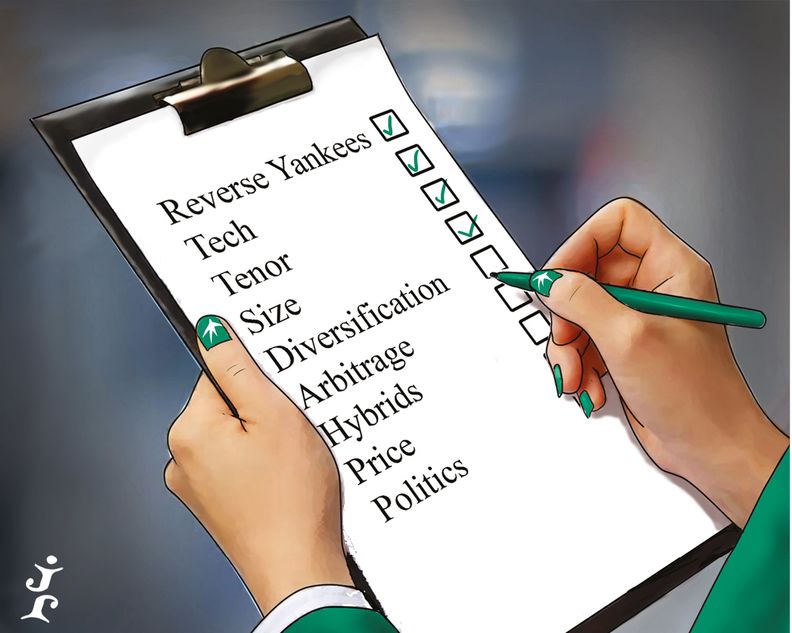
One noticeable characteristic was the market’s ability to provide size, be it Novo Nordisk’s €6bn five-trancher, the largest Nordic euro corporate issue to date, or NTT’s €5.5bn offering accompanying an even larger US$11.25bn piece that constituted the biggest non-yen deal from a Japanese issuer. This latter transaction also spoke to the overseas attraction, a trend more prominent among US credits, where the likes of Alphabet raised substantial cost-effective funding in April, returning in November with a deal that neatly encapsulated the central themes of reverse Yankee issuance: tech supply, longer maturities, size, diversification and arbitrage.
That return came around a time when the market went into overdrive, with compatriot Bristol Myers Squibb treading a similar jumbo path, while closer to home, Germany's Adidas demonstrated the scale of the spread-tightening trend with the year’s tightest five-year.
That tightness was witnessed in the hybrid sector, too, with the compression between senior and subordinated debt tempting issuers. Add to that some Moody’s methodology tweaks, and Europe finally got what many had been expecting for quite some while, namely hybrid bonds from US corporates. Verizon and NextEra Energy were the issuers in question, although there was no question surrounding which bank might be involved in both transactions.
The financials arena also proved a fertile hunting ground, with BNPP straddling asset classes. At the sharper end of the capital market, it focused its attention on the insurance sector, which relies less on reciprocity.
Notable examples came from Achmea, which sold its first RT1 since its debut more than five years earlier, and AXA, which optimised investor penetration and made the most of benign conditions with an RT1/T2 combination.
Echoing the access afforded to overseas corporates, Nippon Life sold a T2 in January that proved so successful it returned with another in August. BNPP was on both.
That is not to say the bread-and-butter senior business was ignored, with the bank sitting in a prominent position in terms of volumes of deals executed.
A relatively rare issuer of covered bonds, BNPP does not enjoy the reciprocity afforded to some others and has to make itself relevant in other ways. The obvious area to explore was outside the eurozone, which it did with aplomb, leading deals for the likes of the UK’s Nationwide, Canada’s CCDJ and Australia’s Macquarie Bank.
In the public sector market, the bank was equally successful, its domicile meaning it was often called upon to provide advice not just to sovereigns but also a swathe of agencies swimming in uncertain seas below.
And away from home, it continued its years-long pattern of servicing old doyens of the market like the EIB and KfW, and newer ones such as the EU.
“The question we ask ourselves is how we can maintain our position in the euro market. Well, by having a better read, by innovation, by judging that all clients are important to us and by integration. Because, ultimately, it’s one team: BNP Paribas,” said Zorzi.