


Emerging EMEA Bond House: Citigroup
Driving the bus
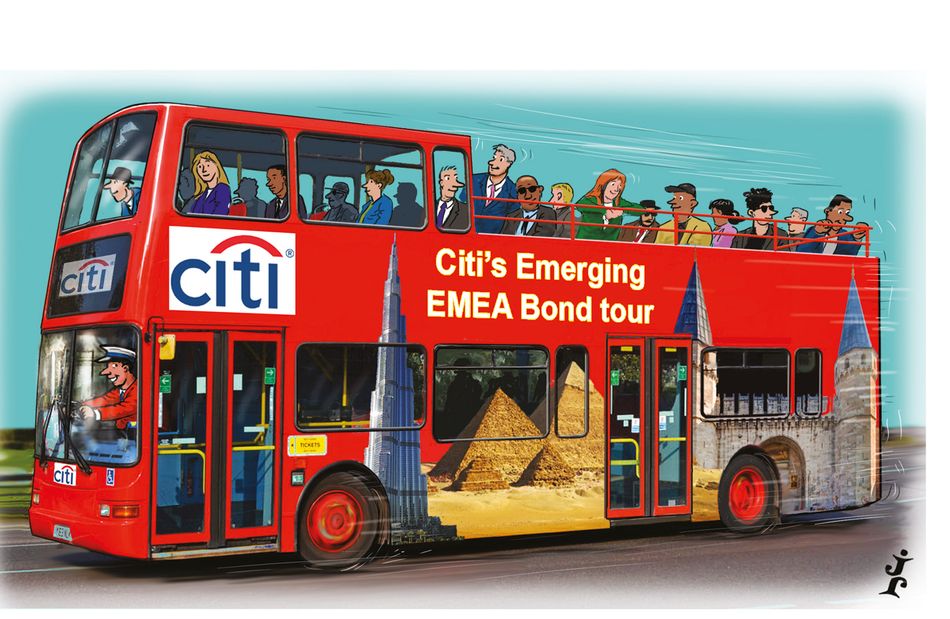
It was a year of transition for Citigroup’s debt capital markets business, with key personnel leaving. But the US bank continued to drive the biggest and toughest deals. For its leadership across the region, Citigroup is IFR’s Emerging EMEA Bond House of the Year.
In a year of record supply for emerging Europe, Middle East and Africa, the latter is the region with the lowest issuance volumes. That’s not to say it’s been immaterial – indeed compared with recent years there’s been a big pickup.
But against volumes from Central and Eastern Europe or the Middle East, it is easy to overlook. However, African borrowers can, at times, have more difficult credit stories, need the most urgent funding or are new to international capital markets.
It’s therefore something of an achievement for a bank to have been on every African sovereign deal during IFR's awards period, as well as issuances by other African-related borrowers. That’s what Citigroup can boast.
Africa is the “single most dynamic part of the market”, said Blazej Dankowski, Citi's co-head of CEEMEA debt financing. The bank identified the possibility of bringing these issuers to the capital markets early and then “took charge", he said. Citi had a hit ratio of more than 80% on all African deals.
It helped bring Kenya twice to the market in 2025, for example, with the sovereign easing any liquidity pressures by undertaking liability management exercises alongside new issues. Angola was another sovereign that has been in the crosshairs but came back to the market in a Citi-led deal.
Those deals involved other bookrunners, but Gabon and Republic of the Congo were sole-led private placements, which helped both borrowers source much-needed funds. Critics will gripe about the cheap pricing – both bonds surged in the secondary – but aftermarket performance was arguably less a concern than just raising the capital and providing both governments with some breathing space.
Away from sovereigns, Citi was on several Africa-related deals, including debuts from Azule Energy and Ivanhoe Mines. Both came on the same day in January, yet neither hampered the other, reflecting Citi’s stewardship and its syndicate desks’ ability to source liquidity and distribute risk.
Citi was not just strong in Africa but across the whole CEEMEA region. It might be ranked number two in the league table but there wasn’t much it missed.
The Middle East is now as important a region as any other. Citi has been involved in almost all the landmark deals, including Saudi Arabia’s US$12bn triple-tranche offering in the equal biggest EM deal of the year; Kuwait’s US$11.25bn triple-tranche transaction in its first deal since 2017; Abu Dhabi’s record tight spread for its US$2bn 10-year bond as part of a US$3bn dual-tranche deal; and Qatar’s record tight spread for a sukuk offering on its US$3bn 10-year tranche as part of a US$4bn transaction. Citigroup was global coordinator on all four deals.
“We differentiate ourselves by being in the global coordinator roles, the billing and delivery roles, the debut deals,” said Victor Mourad, Citi's other co-head of CEEMEA debt financing.
There have been just two corporate hybrids in the Middle East this year – the instrument is a rarity in the region. One, by Majid Al Futtaim, fell just outside the awards period. The other, from Aldar Properties, came in January. It’s a testament to Citi that it was the only bank that was a global coordinator on both, and on Aldar it was sole structuring adviser and global coordinator.
In CEE, whether in the CIS, Central Europe, Turkey or the Balkans, Citi’s DCM footprint is writ large. Some of these deals were far from easy.
Take Turkish high-yield corporate Cimko Cement and Concrete. Pricing on the US$300m five-year non-call two amortising notes offering did not budge from 11%. But the deal got done, which was not the case for every Turkish high-yield corporate.
“We got it over the line,” said Felix Weiss, director of fixed income syndicate at Citi. “We worked with anchor orders to derisk the trade.”
Citi’s success has come against a backdrop of turnover in its debt capital markets team, including the departures of experienced EM bankers Iman Abdel Khalek and Tommaso Ponsele, though he was leading the bank’s investment-grade corporate effort in Europe when he left.
Such is the bank’s deep bench that it has continued to maintain a dominant market share and win business across the board. “We’ve been at the forefront of the higher value transactions,” said William Weaver, the bank's vice-chairman for international DCM. “We’ve invariably been a global coordinator. We’re always driving the bus.”