


Credit Derivatives House: Morgan Stanley
Embracing the revolution
Narrowing bid-offer spreads made it harder than ever for traders to turn a profit in the increasingly automated world of corporate credit in 2025. For leveraging its investments across technology, products and personnel to create a fully integrated credit trading business, Morgan Stanley is IFR’s Credit Derivatives House of the Year.
Investors shrugged off concerns over tariffs and a slowing US economy to push credit spreads near to their tightest levels on record in 2025. The resulting compression in bid-offer spreads threatened to dent the profitability of trading desks that were already seeing margins squeezed from increased automation.
This challenging backdrop played into the hands of firms like Morgan Stanley that have been at the forefront of the technological revolution underway in corporate credit, embracing the seismic shift of these once human-centric markets towards a more equities-like trading paradigm.
Significant and sustained investments in technology, products and personnel needed to navigate this new environment have cemented Morgan Stanley’s place at the top table in credit trading.
Along the way, the US firm has leapfrogged rivals across the full gamut of products – from corporate bonds to credit default swaps, total return swaps and exchange-traded funds – as it has built a comprehensive and fully integrated credit trading franchise.
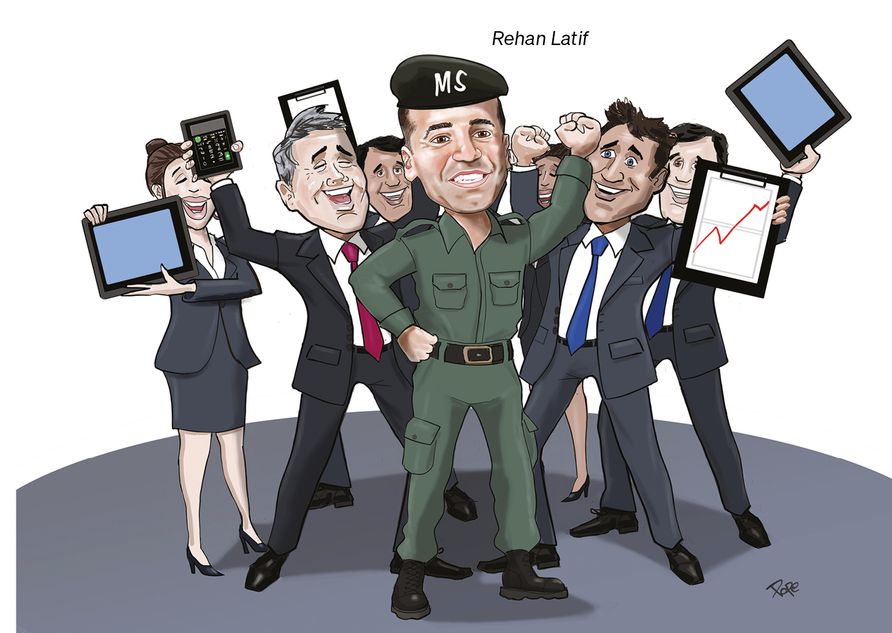
“The business has evolved so much,” said Rehan Latif, global head of credit trading. “We’re talking about a quantum leap difference in terms of the size that clients want to get done, the liquidity they expect … the speed of execution and the bid-offer that they expect to trade at.
“You want to have the full suite of offerings across [derivatives, bonds and ETFs] and that's where we've had a tremendous amount of success,” he said. “Our scale has been a differentiating factor for us.”
The philosophy underpinning the evolution of Morgan Stanley’s credit business has its roots not only in the technological advancements that have upended how corporate bond markets trade. It’s also a reflection of how the firm’s largest clients have come to view the world: taking a cross-product, portfolio-based approach.
Morgan Stanley has adapted by bringing the constituent parts of its credit franchise ever closer together, including a groundbreaking merger between human traders and machines on its corporate bond desk. It has also integrated all the different products it deals across regions – from bonds to derivatives to ETFs – into one cohesive trading platform.
The power of that franchise came to the fore when markets swooned in the wake of sweeping US tariff announcements in April. Morgan Stanley’s set-up allowed it quickly to identify investment opportunities for its more bullish clients. For those looking to buy in bulk, the firm was able to pitch ETFs trading at a discount to their net asset value or total return swaps on indices – rather than reflexively buying smaller clips of corporate bonds.
“Now that clients are doing things on a portfolio level, we had to evolve and adapt to that,” said Michael Faridi, co-head of investment-grade and macro credit sales. “Now we have a unified team that … can address trades that come in and try to price things aggressively, which is why we’ve seen an increase in share.”
The results speak for themselves. Morgan Stanley said its volumes across ETFs, TRS and CDS have increased dramatically since integrating these products into one platform. That resulted in a material jump in its US CDS Index rankings in the third quarter while the bank also said it retained top three positions in both ETFs and TRS. In CDS options, Morgan Stanley said it has nearly doubled its market share since 2023.
In Europe, the bank said it has nearly doubled its derivatives client market share over the past year as it has invested to rebuild the business. That has included hiring a CDS tranche trader and two specialised derivatives salespeople in Europe over the past two years. It has also hired two derivatives specialists in the US and a dedicated ETF trader.
“In the last couple of years, [the Europe and US derivatives] businesses have now been fully fledged, fully invested in and more incorporated into the overall ecosystem,” said Latif.
Morgan Stanley has also been at the forefront of arguably the defining theme in credit markets this year: the AI-led debt financing boom. As well as establishing itself as a leading underwriter, the firm’s derivatives traders have been active in transacting billions of dollars of CDS in companies across the AI sector.
“We've seen a huge increase in single-name CDS volumes,” said Faridi.