


Rats’ tails and private credit: are Basel III’s unintended consequences coming due?
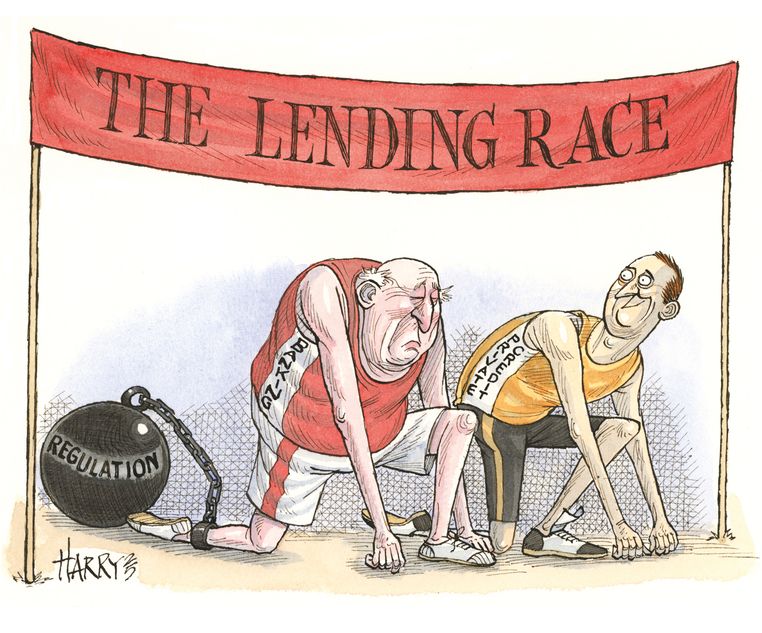
The rise of the private credit market is a consequence of the post-financial crisis regulatory framework. The market’s extraordinary growth, its inherent opacity and the way its risks channel back into the banking system, means regulators need to act now to minimise the impact of any private credit-driven financial crisis.
In 1902 Hanoi, French government authorities introduced a bounty programme in a bid to control the rat population and curb plague risk within the city. After trying and failing with alternative control measures, the authorities offered a reward of one cent for each rat killed to any enterprising local. To collect the bounty, people simply needed to provide the severed tail of a rat.
The scheme surged until French officials noticed live, tailless rats. Investigations uncovered that hunters were cutting off tails and releasing the rats so they could continue to breed and create more offspring with tails to sever. It is reported that people were smuggling rats into the city from outside Hanoi, and “rat farms” or so-called “tail-creation factories” emerged on the city’s outskirts.
The programme was cancelled shortly thereafter, having made Hanoi’s rat problem worse than at the outset. This tale is a crisp reminder that incentive design often seeds unintended consequences.
Finance is littered with design failures. At the heart of every major financial crisis sits a misaligned incentive or disincentive. And indeed, even the new frameworks borne out of a financial crisis, such as Basel III, have unintended consequences. In the post-global financial crisis rebuild, Basel III raised both the quality and quantity of capital that banks are required to hold, added buffers and surcharges for systemically important banks, introduced new liquidity standards in the form of the liquidity coverage ratio and net stable funding ratio, set a backstop leverage ratio and constrained banks’ internal risk-weight models.
Banks were remade as fortresses to curb excessive credit growth and harden resilience. But there was always a question about unintended consequences.
Rise of private credit
As banks came to terms with the Basel III framework, nonbanks found that the doors to traditional banking functions were suddenly wide open. The resulting market – soon dubbed private credit – accelerated after the crisis to a global multi-trillion US dollar asset class.
Of the alternative asset managers that make up the private credit market, private equity firms predominate, controlling more than three-quarters of assets under management. But a significant subset of private credit is asset-backed finance, in which receivables, leases or loans are pooled and financed, much like standard securitisation structures over mortgages.
The market serves companies that banks, constrained by post-crisis regulation, deem too risky or unsuitable for traditional lending and that are too small (or unwilling) to meet the disclosure and process costs of public markets. The market offers privately negotiated, bespoke terms, often with greater flexibility in stress, that fill the financing gap that traditional channels do not.
It was inevitable that cracks would emerge in an unregulated and opaque market, against a volatile economic backdrop. And they have. In October, the International Monetary Fund, as well as several regulators, urged policymakers to pay closer attention to private credit after two high-profile US bankruptcies in September 2025: Tricolor and First Brands. What is most notable about both is the underlying mechanics that gave rise to such failures.
Dependence on collateral surety
Tricolor’s collapse was the result of a textbook violation of the first rule of asset-backed finance: that collateral can be traced, verified and pledged effectively and unequivocally.
The company’s business model depended on pooling subprime auto loans, financing them through warehouse credit lines and securitisations, and recycling capital into new originations. What went wrong was collateral integrity.
Warehouse banks allege that the same loan assets had been pledged to multiple facilities – essentially, the same dollar was promised twice. That allegation strikes at the core of securitisation. A transaction’s hierarchy of seniority, credit-rating profile and price rest on the premise that every asset in a pool has a clear legal owner. Once this premise is broken, every subsequent component built on it loses its foundation.
The consequences were predictable. With warehouse lines already drawn, lenders moved to enforce but were unable to perfect their security or realise the collateral, so the balance sheet hit was immediate. Their secured exposure was, in fact, unsecured. US authorities have opened investigations, with litigation expected to follow.
First Brands reads like the ultimate exercise in smoke and mirrors. No single creditor had a consolidated view of the company’s liabilities because financing was deliberately spread across overlapping, siloed channels. Receivables were allegedly sold, pledged and referenced in multiple programmes at once. The result was simple and brutal: a material hole, currently in the order of US$2.3bn, between creditors expectations and the assets actually available. Many creditors now find themselves functionally unsecured against the smaller, contested pool, with investigations and litigation the only path to clarity.
Both cases point to a single lesson: governance failed. A failure of collateral and cashflow surety at this scale is not just accident or poor operational and administrative process; it reflects incentives that dulled verification, weakened diligence and diluted accountability.
And these cases do not look isolated. In October, BlackRock’s newly acquired HPS Investment Partners alleged asset-backed financings it had invested in had been subject to fraud, again centring on whether pledged collateral actually existed, and in November, BlackRock marked its private loan to Renovo Home Partners to zero after Renovo’s abrupt bankruptcy.
Dependence on plumbing
These failures also signpost where the pipes run: back to banks. The IMF’s October 2025 Global Financial Stability Report highlights that banks in the US and Europe sit on roughly US$4.5trn of exposure to nonbanks, with US$2.6trn as loans and the rest as undrawn commitments. Within that, about US$497bn is to private equity and private credit funds, up 59% between the fourth quarter of 2024 and the second quarter of 2025, and about half the US banking sample, by assets, already carries nonbank exposures exceeding Tier 1 capital.
The Bank of England has also recently quantified this dependence – in its December 2025 Financial Stability Report. It estimates that UK banks have £173bn of banking book exposures to private market funds and sponsor-backed corporates, which is roughly 67% of aggregate Common Equity Tier 1 capital.
In other words, the clearing, hedging and committed liquidity that make private markets hum remain bank balance sheet functions, and they are large enough to matter for bank solvency maths.
The analogy is a central boiler feeding a house full of radiators. Heat circulates through many rooms, but the pressure and hot water come from one unit. When markets turn cold, that unit must deliver flow immediately, in cash. In effect, banks have been left underwriting the convertibility of nonbank structures into cash. It is insurance embedded in the financial system’s plumbing.
Dependence on accurate data
Despite strong evidence of bank and private credit linkages, the biggest constraint remains granular, comparable data on where stress starts and how it spreads. Recent global financial stability reports from the IMF underline the gaps, and UK policymakers have echoed the point.
The BoE’s December report highlights that several major UK banks could not uniquely identify and systematically measure their combined credit and counterparty exposures to the private equity ecosystem within their overall risk data.
Visibility is limited because much of private credit sits outside public disclosure and uses heterogeneous documentation and valuation practices. The result is that supervisors and investors cannot readily see who ultimately bears the risk, or how quickly exposures could turn into liquidity or solvency stress in a downturn.
The data gap matters most when stress hits. Without consistent reporting, authorities cannot map the pipes between funds, their investors and banks. They cannot run system-wide liquidity drills and cannot assess concentration across sponsors and leverage providers.
The IMF’s prescription is dull but right: adopt a more intrusive supervisory approach to private credit funds, their institutional investors and leverage providers by requiring greater disclosure on leverage, interconnectedness and investor concentration. The key is to illuminate links between banks and nonbanks so supervisors can stress test the private credit ecosystem more effectively.
Inflated ratings
The rating agencies were at the centre of ratings inflation prior to the global financial crisis, and their role is again central in the private credit market in which mandates hinge on ratings, notably in insurance portfolios that hold meaningful private credit exposure.
Insurers’ allocations lean on the investment-grade label, which lowers capital charges and satisfies mandate requirements. As a result, portfolios depend on private ratings from specialist agencies, often via non-public “private letter” assessments with hard-to-compare methodologies.
In its most recent global financial stability report, the IMF flags the growing use of such ratings in the US and a shift towards specialist raters, warning that misclassification can leave insurers undercapitalised when shocks arrive. A recent BIS report goes further, noting the scope for ratings shopping. It highlights that by late 2024, about 23% of PE-linked US life insurers’ identifiable investments relied on private letter ratings versus 8% for other insurers. The risks are straightforward: first, opacity raises the chance that sub-investment-grade assets sit in investment-grade buckets; second, when cuts come, they often come together, forcing sales or extra funding at the worst time, when liquidity is thinnest and markets are in freefall.
Forgotten lessons
The recent failures echo a pre-2008 pattern. Back then, bank-sponsored off-balance-sheet vehicles, such as structured investment vehicles and asset-backed commercial paper conduits, borrowed short and bought long. They issued what seemed to be cash-like paper to fund portfolios of longer-dated higher-quality assets, and investors assumed two things would always hold: prices on those assets would stay stable and short-term funding would always roll. When asset prices became uncertain and lenders asked for more collateral, that funding stopped rolling, ratings dropped and the sponsoring banks had to step in. Paper that behaved like cash in good times behaved like unsecured credit in stress.
Could the demise of Lehman Brothers have been averted after the SIVs collapsed? No one can know. But in hindsight the lesson is clear: close the gap between a liquidity problem and a solvency problem quickly, and do it in full daylight.
Policymakers should have forced an early choice: either make banks bring those risks back on balance sheet and recapitalise them, or offer a temporary, priced public backstop to buy time for orderly winddowns. They also needed the tools that arrived only later: pre-positioned resolution powers for large vehicles and their bank sponsors, stress tests that include funding withdrawals and collateral calls, and simple, standardised disclosures so everyone could see where losses would land.
For banks, the playbook was brutal honesty and speed. Term out fragile funding, cut reliance on short-term wholesale markets, bring hidden risks back on balance sheet, take the marks, raise equity and pause distributions until funding strength returns. Hedge or shed the hardest-to-fund assets and use central bank facilities early rather than late. Align incentives with resilient funding and sustainable profitability and keep a single view of contingent liquidity so the same dollar is not promised twice.
The relevance today is clear. If banks provide liquidity and funding support to the private credit ecosystem, the strategy is the same: show where the cash calls will hit, prefund the backstops, and rehearse the winddown while the lights are still on.
Where next?
If we apply foresight based on the GFC hindsight, three levers matter to minimise the impact of any private credit driven financial crisis.
First, make the risk visible. Regulators should require a single, standardised reporting template for private credit managers, their vehicles and financing counterparties, and material institutional investors on the same core dataset covering two realities: direct exposures that exist today, and the contingent exposures that can appear tomorrow when collateral is questioned or lines are drawn.
It is the second category that ambushes systems, because it can all arrive at once and needs liquidity and/or capital. The goal is not more rules but clear sight. You cannot manage what you cannot see. Only then can you rehearse, stress test and agree in advance how an orderly winddown would work. The BoE underscored this in its December 2025 report and will undertake its next system-wide exploratory scenario exercise, focused on the resilience of the private markets ecosystem, alongside its bank capital stress test workstream.
Second, price and prefund the risk. Treat standby credit lines and warehouse exposures as real claims that arrive in bad markets. Do not promise the same dollar twice. This is not exotic; it is simply accepting the claim will come and being ready to cover it.
Finally, plan the exit with no call on the taxpayer. The largest private credit managers and their funds should create clear winddown plans. Neither central banks nor supervisors should provide financial support in stress; their role is to oversee and approve an orderly winddown. If that rule is good enough for banks, it is good enough for private credit funds and their sponsors. Resolution should be private, not public. And a contained (and dull) failure is acceptable.
Hanoi’s lesson travels well. Picture a rat whose tail was cut and sent back into the street. If the reward is for tails, you get tailless rats. If the reward is Basel III risk-weight optimisation, the rats run behind the walls.
The fix is simple to say and hard to do: pay for visibility and the behaviour you want, price the risks and backstops you already provide, and prepare for an orderly unwind.
Prasad Gollakota is a former FIG banker and co-head of the global capital solutions group at UBS. He was later chief content and operating officer at edtech company xUnlocked and specialises in financial institutions, banking regulation, capital markets and complex capital and funding solutions.