


Banks and private credit: the best of 'frenemies'
The finance providers may be rivals but they also rely on one another. That symbiosis will only increase.
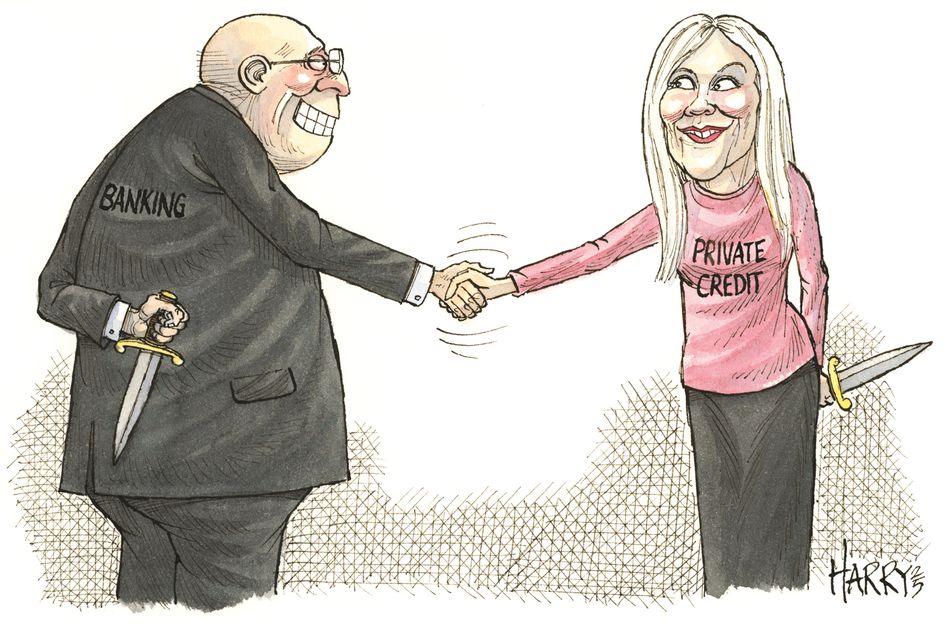
“Eat or be eaten” – that is what we are used to hearing when it comes to the relationship between banks and private credit managers.
But the reality is that the two sides are “frenemies” in that they compete but also can’t live without each other.
Banks no longer want to provide tons of large, long-duration funding to companies or get involved in creditor-on-creditor violence and debt-to-equity swaps in lower-rated companies. They are relatively happy to see that kind of routine lending head to private credit, but they don’t want to lose out on the other much more lucrative fee-based activity that used to (at least in theory) come out of those lending relationships.
Corporate lending was historically a beachhead. It was often a loss-leader but part of a broader integrated corporate relationship across higher return-on-equity businesses, including investment banking, transaction banking and macro hedging/trading.
There are three areas in which banks and private credit firms are either already working closely or will get closer in the next few years: financing, origination and trading.
Financing
Banks want to be able to compete for certain lending relationships. That's why JP Morgan set up a private credit business in 2021 as a partnership between its markets, banking and asset management businesses that combines the bank’s balance sheet with those of third parties.
It's also why JP Morgan CEO Jamie Dimon signed off on what was at the time the largest ever corporate debt underwriting by a single bank (US$20bn) in the US$55bn Electronic Arts buyout, though that underwriting has since been eclipsed by Wells Fargo’s US$29.5bn commitment to the proposed Netflix/Warner Bros Discovery studio and streaming deal.
Banks may have reduced their corporate lending over the last decade, especially to more risky middle-market borrowers, but they have substituted that with indirect exposure by lending to nonbank financial institutions like private credit firms.
Barclays estimates that returns on equity on NBFI loans can be three times higher than on direct lending to corporates. Regulation means that risk weights for banks on NBFI lending are typically a fraction of that on direct lending, minimised by focusing on senior tranches. It is also collateralised and kept away from the booming use of payment-in-kind financings.
There are numerous ways that banks provide leverage to the private credit ecosystem. For instance, they lend against the fees generated by private credit funds, against a fund portfolio’s net asset value or with loans secured on specific assets.
Moody’s estimated bank sector exposure to private credit vehicles was already more than US$500bn in 2024. According to the International Monetary Fund, many private credit funds offer revolving facilities to their borrowers and mitigate the risk with their own revolving credit lines at banks.
Origination
The core of the private credit market until recently was middle-market firms that are often too small for the high-yield bond market. Such firms have borrowed directly from private credit firms without any intermediation by investment banks. The term “direct lending” refers to this sub-segment.
But private credit’s recent growth – and a bigger slice of its future growth – is expected to come from lending to large, investment-grade companies – what Marc Rowan, CEO of Apollo, refers to as a US$40trn addressable market. Clearly, that’s a much bigger pie to play for than the low-single-digit billions of US dollars in the lower-grade leveraged loans market.
Private credit cannot compete with the huge liquidity and tight pricing of the large cap investment-grade bond market. Those bonds will continue to rely on banks to distribute them to the buyside.
But the asset-backed investment-grade lending markets are huge, across not just corporates but different types of consumer debt. Some private credit giants can source much of their investment-grade flow without banks. For instance, Apollo’s 16 direct origination platforms across aviation, equipment, trade finance and other areas of asset-backed and speciality investment-grade private lending employs nearly 4,000 people.
Nevertheless, given the huge volume of money being taken by the private market giants in this area, banking relationships are likely to be just as important. Apollo has signed strategic partnerships with 12 major banks. With corporates, a bank may have deep relationships given the roster of products they already sell to them.
In 2024, Citigroup and Apollo announced a partnership for the latter to invest at least US$25bn through private credit deals that Citi would find for it, initially in North America. In December 2025, Citi was transaction adviser for the US$745m financing between Apollo and Virgin Atlantic, with its Heathrow airport slots used as collateral.
As if to underline the emergence of private credit into the biggest of lending leagues, Apollo joined Citi and Bank of America in underwriting a US$54bn senior secured 364-day bridge loan to support Paramount's US$108.4bn hostile counterbid to acquire all of Warner Bros Discovery. It could hardly be further from the middle-market arena where private credit developed.
In specific sectors like energy transition or AI data centres, firms will want to finance these huge projects as asset-backed loans from private credit firms. Given the bespoke terms of such deals, there is a role for bankers to create the most appropriate structures. If the debt is shared among many parties, not just one private credit firm, there will likely be a need for a bank to act as an intermediary.
The record US$27.3bn Meta Platforms/Blue Owl Capital private deal to finance the construction of a jumbo AI data centre looks, from the headlines at least, like a move away from traditional market participants to private credit managers. But dig into the details and you will see Morgan Stanley’s advisory role and that most of the debt was sold to bond investor Pimco and not held by traditional private credit players.
Private credit firms also rely on banks when they create CLOs, leveraging their skills in structuring and distribution.
Trading
Interconnected to this is a third area that is much less significant but could be a major area of collaboration in the future: trading.
A lack of liquidity is a feature of private credit, not a bug. For all the press releases saying private credit managers and big banks are creating secondary market liquidity for loans, end-investors historically liked the “volatility laundering” of private markets.
Recent troubles may change that. How happy are BlackRock clients who saw loans to home improvement company Renovo at 100 cents on the dollar one month and then zero only a month later? The wide dispersion in the marks that private credit players are putting on some nonperforming loans is also garnering attention, especially from regulators. This will only become a bigger issue when the credit cycle turns.
But the biggest driver of secondary market activity may be the structural pivot of private credit from leveraged middle markets to investment grade. Not only are these offerings larger and likely to have more investors, there is potentially interesting arbitrage or spread trades for investors between these and the plain vanilla bonds issued directly by the corporate backer. For instance, the private credit bond issued by the Meta/Blue Owl joint venture trades around 100bp wider than Meta’s bonds.
And the wall of issuance coming thanks to the AI capex binge will create a series of large private credit issues. Large asset managers that traditionally focused on public market investing are now lining up to partner as distributors of private credit to wealthy individuals, while ETFs are emerging that combine bonds and private credit.
To get a sense of the size of a potential trading boom, try this: Rowan has said Apollo traded more than US$6bn of investment-grade private credit in 2025 – tiny compared with the nearly US$60bn traded in US corporate bonds every day.
Investment bank credit trading desks have seen massive margin pressure from electronic trading, portfolio trading and increased competition in recent years from firms like Jane Street. They were very late to the bond ETF trading party, so will want to be early movers when these jumbo private credit issues start to trade. Volumes may not be huge but bid-ask spreads are likely to be wide and, with less price transparency, the business could be highly profitable.
Typically, credit trading desks have the strongest market share in bonds that they helped originate and distribute. With DCM desks involved in the allocation and distribution of some of these private credit investment-grade issues, there should be a similar post-issue halo effect.
The surge in the number of participants that have entered the private credit space will also create more potential buyers and sellers of large private credit issues. Hedge funds, capacity constrained in public markets, are rushing into private credit. Millennium Management, which is probably a top-three counterparty of sellside trading desks, is raising a dedicated US$5bn private credit fund, for instance.
The largest private credit players also have public markets businesses and are already top clients of bank trading desks and DCM.
Despite regulatory concerns about systemic risk from banks providing leverage to private credit, the relationships are likely to deepen. Even if banks pull back on indirect lending to the lower-rated leveraged private credit segment, growth in origination, financing and trading of investment-grade private credit is likely to outpace this.
Banks are in the moving business, and private credit is in the storage business. They are – and will be – stronger together.
Rupak Ghose is a corporate adviser and former financials research analyst. Read his Substack blog here