


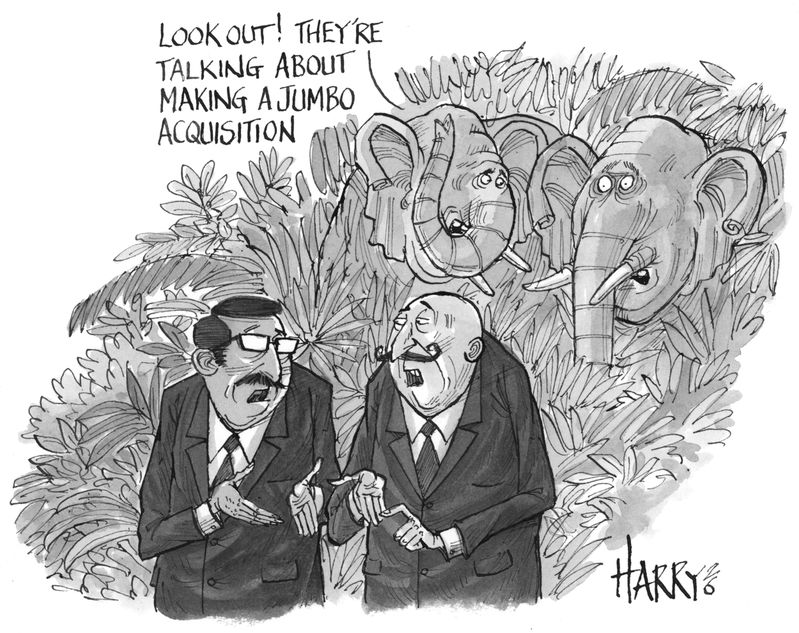
India Inc’s acquisition spree last year that took outbound M&A dealflow to a 15-year high is expected to provide further financing opportunities, with mid and small-cap companies jumping on the bandwagon.
Mining equipment maker Tega Industries and IT services firm Coforge are among the listed companies looking to tap the loan market to fund overseas acquisitions, with several others expected to follow.
“Access to technology, manufacturing or a large consumer market are among the drivers for Indian companies eyeing overseas acquisitions,” said a senior loan banker in Singapore. “We have half a dozen mandates on debt financings backing outbound M&A for Indian companies from a variety of industries such as engineering, pharmaceuticals, specialty chemicals and technology, among others.”
Tega is acquiring an 84% stake in mining materials manufacturer Molycop at an enterprise value of around US$1.45bn alongside funds managed by Apollo Global Management that will own the remainder. Tega will borrow up to Rs15bn (US$165m) on its balance sheet via an amortising seven-year loan and around US$900m will be raised on a non-recourse basis to repay debt at Molycop.
Coforge is buying US-headquartered AI engineering firm Encora and plans to raise a three-year term loan to refinance the debt portion of the acquisition’s US$2.35bn enterprise value. The US$1.89bn equity component will be financed through a share swap arrangement.
These acquisitions were announced last year when crossborder M&A deals from Indian corporates soared to the highest level since 2010. In 2025, India’s outbound M&A dealflow surged to around US$23.6bn from 314 recorded transactions, almost triple the US$8.3bn in 2024, according to LSEG data.
Tata Motors’ offer to buy Italy’s Iveco Group for €3.8bn was the largest debt-funded transaction, followed by Coforge and Tega’s acquisitions, as clean balance sheets with room to borrow fuelled dealflow.
“The Indian buyer has delevered its balance sheet, so it is able to raise debt at a low cost to cover 70%–100% of the acquisition value and pay the price that sellers are looking for,” said one M&A loan banker.
Indian companies are using the easy access to capital to acquire foreign firms bigger than themselves.
Tega’s debt financing of around US$1.07bn represents at least 70% of the US$1.45bn in enterprise value at which it agreed to purchase Molycop in November. Tega reported revenues of US$192m for the financial year to March 31 2025 whereas Molycop’s revenues were eight times higher at US$1.53bn for the year to June 30.
Attractive terms
Acquirers are also able to obtain low pricing for debt as banks compete to lend to strong credits.
Coforge was considering a qualified institutional placement of shares as an option to raise US$550m to retire debt at Encora, but found the rates banks offered for the loan to be more attractive after negotiating pricing down to the mid-single digits.
“Coforge is rated AA+ in India so their pricing expectations would be low-to-mid hundreds and banks will give that pricing to them,” the M&A loan banker said.
Tata Motors paid tight pricing on the €3.875bn bridge loan backing its acquisition of Milan-listed Iveco, yet drew a strong response with 19 lenders joining in syndication and taking 87% of the deal.
The financing is split into two equal tranches – one carries a guarantee from Tata Motors, while the other has a letter of support from the parent. The guaranteed tranche offers a blended margin of 97.5bp over Euribor, while the other pays 107.5bp. The blended margin for the overall financing is 102.5bp, and the margins for both tranches step up from the seventh month.
“If companies with strong balance sheets were to fully finance their acquisitions with debt, they would still have a strong pro forma credit profile and be able deleverage very quickly because they throw up cash,” another M&A loan banker said. “So it is an extremely attractive opportunity to provide funding to such borrowers.”
While the number of outbound M&A deals has increased, corporates are able to fund smaller acquisitions with cash. Companies usually tap debt only when the acquisition cost is US$500m or higher, the second M&A loan banker said.
“Since these companies don’t borrow much, banks are extremely sensitive about losing out on mandates and a lot of deals get clubbed even at a US$500m size, with banks holding around US$100m each,” the banker said.
Additional reporting by Prakash Chakravarti