


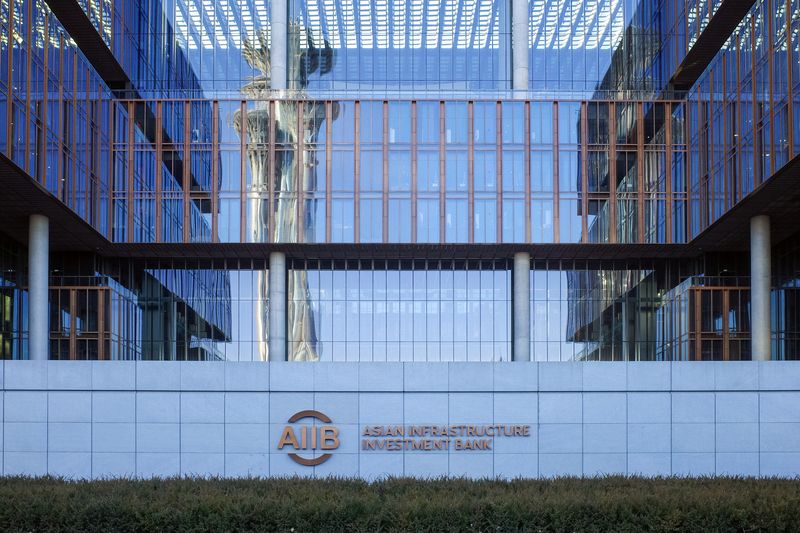
The Asian Infrastructure Investment Bank is ramping up its focus on climate financing as it seeks to burnish its credentials in driving infrastructure connectivity.
The bank is targeting climate-resilient energy and transport infrastructure financing to support the decarbonisation process of its members and clients, chief investment officer Lim Kim-See said.
“The AIIB will continue to use its sovereign budget instruments to help members accelerate their national reforms aimed at speeding up their low-carbon transition and mitigating climate change impact,” said Lim in an e-mail interview.
One way is through expanding its climate policy-based financing programme in Asia, which saw the AIIB and the Asian Development Bank lend US$400m each to the government of Bangladesh in 2024 to help fill a large financing gap in its national development expenditure.
Through the programme, the AIIB helped coordinate reforms across the country’s energy, transport, agriculture, water sectors and urban development to minimise losses related to climate change, which average US$3bn annually according to some estimates.
“Another climate policy-based financing is being designed with the government of Indonesia. Looking ahead, more members in Asia are expected to advance reform programmes supported by this financing in 2026,” Lim said.
Over the past decade the Beijing-based multilateral development bank has approved nearly US$72.4bn in financing across 373 projects in over 40 economies. In 2024, US$5.6bn, or 67% of the total approved financing, was classified as climate finance, Lim said, up from 60% (US$3.43bn) and 56% (US$2.39bn) in 2023 and 2022 respectively.
As a rough comparison, climate financing by the Asian Development Bank reached US$12.28bn in 2024, about 31% of its total committed financing and partners’ cofinancing. It made a commitment that year to grow climate financing to half of its total annual committed financing by 2030.
In the energy sector, the AIIB in 2020 declared a halt on financing any coal-fired power plants or coal-related projects. It has been focusing on renewable energy, and expanding and modernising electricity grids.
Its financing to promote cross-border connectivity and infrastructure also seeks to mitigate climate change. In March, the AIIB approved a US$300m senior unsecured loan to Manila-headquartered container port operator International Container Terminal Services (ICTSI) for boosting capex spending at its ports in the Philippines. Part of the loan terms includes requirements for ICTSI to replace diesel-powered cranes with hybrid models, and introduce energy-efficient technologies to reduce carbon emissions.
Last October, Lim led the signing of agreements with AmBank, CIMB, development bank Bank Pembangunan Malaysia and Malayan Banking, which will see the AIIB invest up to US$2bn in the ASEAN Power Grid in cooperation with both public and private sectors. The initiative aims at connecting electricity networks of ASEAN’s 10 member countries to achieve fully integrated grid operations by 2045.
This followed its US$52m loan to Sri Lanka’s government in the same month to finance the construction of a 220kV underground cable to channel renewable power from the northern and eastern regions towards the electricity load centres in Colombo to ensure uninterrupted power supply.
Engaging private capital
The AIIB is also taking steps to attract more private capital by broadening its spectrum of financing tools, which range from B-loans, risk transfer and capital market instruments such as debentures and equity, and fund participation.
In February, AIIB said it would invest US$75.5m in Keppel’s private credit fund III. The fund aims to provide direct debt financing to mid-cap companies in the infrastructure sector primarily across Asia Pacific. This followed its US$150m investment in January 2022 into Keppel’s Data Centre Fund II, which targets emerging Asian markets.
The total amount of non-sovereign backed financings, or those made to private enterprises or public sector entities that are not guaranteed or indemnified by a member, reached US$2.87bn across 27 projects in 2024, up 21% from US$2.36bn over 25 projects a year earlier. These accounted for about 34% of AIIB’s total approved financing amount in 2024.
Under newly appointed president Zou Jiayi, China’s former vice-minister of finance, who assumed office in January 16 coinciding with the bank’s 10th anniversary, the AIIB will continue to directly engage institutional investors in its non-sovereign backed projects in Asia. It aims for private sector financing to reach a 50% share of its approved annual financing by 2030, Lim said.
“[The 50% goal] reflects AIIB’s ambition to reshape infrastructure finance in Asia by ensuring private capital enters earlier, at scale, and will continue to play a role even after the development bank’s involvement concludes,” she said.
Initially floated as a China-led alternative to international multilateral development banks, the AIIB has grown rapidly to 111 members from the 57 countries it was founded with over a decade ago. In the process it is shedding the perception that it is closely aligned with China’s Belt & Road Initiative.
“We do not finance projects under any single national initiative. Where projects align with our mandate and meet our policies, we work with a wide range of partners to support sustainable infrastructure and the energy transition across our membership,” Lim said.