


Lenders cast wary eye over Trump-driven Japan-US financings
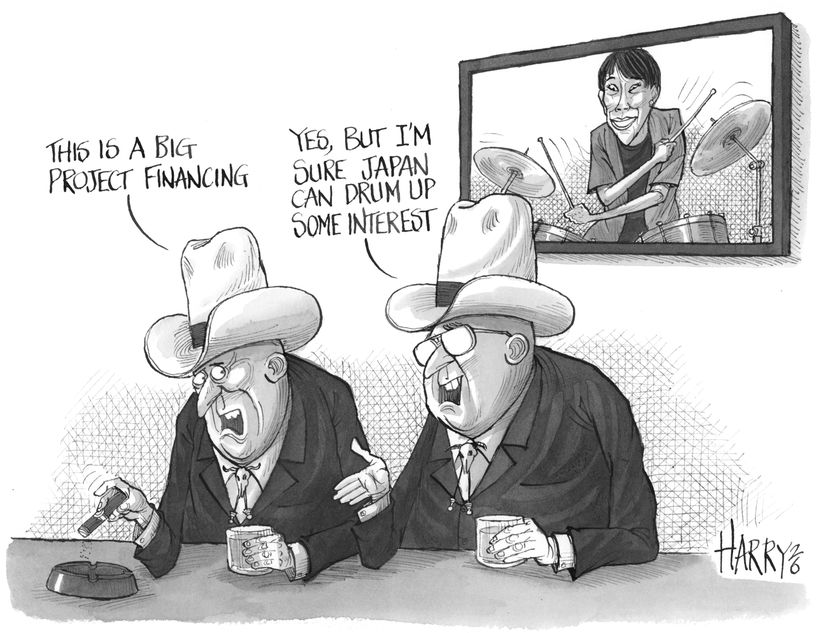
Japanese export credit agencies are in talks with Japanese and US commercial banks over jumbo financings to support large-scale infrastructure projects under Japan’s planned US$550bn investment programme into the US.
On March 19, the two countries announced a second batch of energy projects requiring up to US$73bn in investment from Japan, following an initial tranche of three projects totalling US$36bn announced in February.
Among the latest projects are a US$40bn small modular reactor production facility, to be built in Tennessee and Alabama for GE Vernova Hitachi, a joint venture between General Electric and Hitachi, and a US$33.3bn gas-fired power plant in Ohio for a US data centre complex for SB Energy, a US affiliate of SoftBank Group.
Japan Bank for International Cooperation is expected to provide roughly half the financing required, with the remainder to be raised from commercial banks. Nippon Export and Investment Insurance is expected to provide partial guarantees for the commercial portions.
The projects are part of a landmark bilateral trade agreement between Japan and the US concluded in July, under which Tokyo committed to invest as much as US$550bn in the US economy in exchange for tariff reductions on key Japanese exports, including automobiles and electronics.
The sheer scale of the funding requirement could strain market capacity, however.
“It is an extremely difficult deal, as it is a scheme no one has ever executed before,” said a Tokyo-based project finance banker referring to SB Energy’s gas-fired power plant.
Another banker said deal structures could be adapted to cater to varying risk appetites, such as creating separate tranches with and without guarantees.
Political and ESG risks
Although Nexi’s support reduces credit risk, lenders are concerned about political risk as the investment framework will remain in effect beyond the scheduled end of Donald Trump's presidency in January 2029.
“I am worried about what happens when the Trump administration changes,” a senior banker said. “We have set up a dedicated taskforce but it still feels like we are being pushed into it.”
The basis for the initial trade agreement has also been called into question after the US Supreme Court in February ruled that country-by-country tariffs imposed by Trump under emergency powers were illegal. In response, Trump imposed a 10% tariff on most imports.
To implement the investment pledge, Japan in September amended the JBIC Act, expanding the ECA’s mandate to allow financing of advanced sector projects in developed economies, marking a significant shift from its focus on emerging markets.
In October, JBIC established the Japan Strategic Investment Facility, which will channel funding until March 2029.
While the facility has no formal lending cap, financing even half the Ohio power project would nearly double JBIC’s US$9.4bn in new commitments during the fiscal year to March 2025, underscoring the extraordinary scale of the programme.
Nexi has also stepped up its internal capacity, establishing a Japan-US strategic investment department in January, following the creation of a dedicated taskforce in September.
Despite reservations among lenders, Japanese industrial groups could benefit from participation, gaining opportunities to export technologies to the US. Japan is a leader in low-carbon technologies, including carbon capture and storage, and high-efficiency turbines, positioning itself as a key contributor to decarbonisation efforts in the US.
“As electricity demand from AI data centres surges and power supply constraints intensify, relying solely on renewables is unrealistic,” said a banker at another Japanese financial institution. “Gas-fired power is the most pragmatic transitional option.”
Japanese banks have traditionally classified nuclear power generation as a high-risk sector and have avoided providing project financing that directly assumes construction risk for new reactors.
However, bankers said they may engage on a limited basis where projects are backed by government involvement or state guarantees.
Japan has sought to reduce its reliance on nuclear power since the Fukushima nuclear disaster in 2011, but in August 2022 the administration of Fumio Kishida, the prime minister at the time, reversed course, re-embracing nuclear energy as part of its long-term energy transition strategy.
“Given the limitations of renewables and the reality that certain power sources remain indispensable, nuclear power is likely to gain renewed momentum as a transitional baseload source,” said a senior banker at another Japanese bank.
Some lenders may be unable to participate, however, because of internal ESG-driven lending constraints, particularly around nuclear power and fossil fuel power generation.
Beyond major Japanese and US banks, big-ticket lenders such as European banks and Japanese insurers are widely expected to shun these deals, regardless of state-backed risk mitigation.