


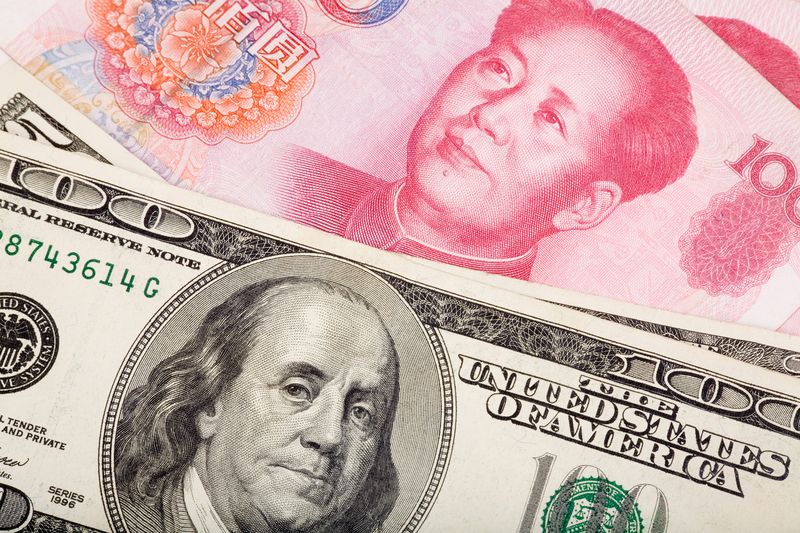
As policy uncertainty in the US weighs on the dollar and raises questions about its status as the dominant reserve currency, it is also giving a fillip to China’s ambitions of currency internationalisation, analysts say.
The ICE US dollar index, which measures the dollar against a basket of six currencies, has declined by more than 8% this year.
The obvious beneficiaries from this search for an alternative to the greenback, dubbed de-dollarisation, are the euro and the yen.
However, the increasing chatter on the search for alternative assets has opened up “the debate on the renminbi as a reserve asset and long-term plans towards renminbi internationalisation,” said Dwyfor Evans, head of Asia-Pacific macro strategy at State Street Markets.
“I don’t see the dollar in any shape or form losing its role as a dominant currency in the world, but clearly in certain parts, certain industries, certain corridors – we see a rise in the renminbi in terms of usage,” agreed Ole Matthiessen, head of Deutsche Bank’s corporate bank for Asia-Pacific, the Middle East and Africa, and global head of cash management.
“It is very natural when US policy is uncertain that the market will look for alternatives to the dollar to diversify their currency holdings and exposures and this applies to investors as well as corporates,” said Kelvin Lau, senior economist for Greater China and North Asia at Standard Chartered. “This is not just a short-term thing because of tariff policies. We think that the renminbi will continue to benefit from this diversification trend.”
Standard Chartered’s Renminbi Globalisation Index rose by about 8.3% this year to the end of April. The monthly index, developed in 2012, tracks offshore renminbi deposits, trade settlement and other international payments, Dim Sum bonds and certificates of deposits issued and foreign exchange turnover from an offshore perspective and denominated in renminbi.
The dollar’s weakness allows the People’s Bank of China to relax outbound flow channels without worrying too much about excessive weakness in the renminbi, according to Ju Wang, head of Greater China FX and rates strategy at BNP Paribas.
“This provides China a nice window to go ahead with liberalisation. The timing is perfect for renminbi internationalisation to accelerate without too much worry about domestic financial stability and currency stability, at a time when the world needs funding,” Wang said.
The use of the renminbi to settle Chinese exports has risen from 15% in 2021 to about 30%. China’s central bank last week reportedly asked major lenders to raise the share of renminbi when facilitating cross-border trade, aiming to raise the ratio of renminbi-denominated trade transactions to 40% from 25%.
“[China] wants people to use renminbi for day-to-day business or investment for diversification and allocation reasons. Trade settlement in particular is one of the safest and most sustainable forms of renminbi internationalisation,” Standard Chartered’s Lau said. “China accounts for such a big proportion of global trade and the amount of that trade being settled in renminbi is disproportionately small. It is just natural for China to keep pushing in that direction.”
Deutsche Bank’s Matthiessen highlighted that the use of the renminbi to settle commodities deals is becoming more frequent and major oil and gas deals with Russia, Saudi Arabia, and Brazil are increasingly renminbi denominated. For example, 10% of Saudi oil exports to China are now in renminbi.
In another move that will help internationalise the renminbi, the Shanghai Futures Exchange has released draft proposals to further open domestic futures for commodities including nickel to overseas investors.
China’s efforts to open up capital markets are “not just about giving access to people to the markets but also complementing that with the right tools for foreign investors to hedge their exposures and risks and manage liquidity,” Lau said.
The Shanghai Futures Exchange’s plan to expand the availability of its derivative products to foreign investors addresses that need.
“There are a lot of efforts from policymakers in China in trying to position themselves as a clear alternative, as a country that respects the rule of law, with increased efforts on international diplomacy as well,” said Abhay Gupta, APAC rates and FX strategist at BofA Securities. “Over time, these things will benefit the renminbi. It is a longer-term process and over time we will see more diversification.”
Even so, despite the renminbi being the world’s fourth-most transacted currency, it accounts for only about 4% of global payments, according to data from global payments company SWIFT. The renminbi still only accounts for 2% of global foreign exchange reserves.
Chinese authorities’ years-long efforts to internationalise the renminbi have faced setbacks, including the PBoC’s devaluation of the renminbi in 2015, and experts noted that even as the renminbi is making steady progress as a global currency, its rise remains dependent on structural and geopolitical factors.
“Excessive currency management, lack of suitable renminbi-denominated assets, the absence of convertibility and on-going restrictions are among challenges for the currency’s internationalisation,” State Street’s Evans said. “So, the shift is very, very gradual."
To be sure, experts agree that China’s renminbi internationalisation plans are not about toppling dollar dominance but wanting the usage of its currency to better reflect China’s actual global economic and financial influence.
“It is about having a matching status for its currency,” Standard Chartered's Lau said. China also wants to diversify its investors’ and corporates’ reliance on the US dollar “especially when US-China relations could be tense at times. It is about having the renminbi as a plan B to fall back on in case the dollar is weaponised in the US-China trade talks.”