


Hans-Joerg Rudloff: a swashbuckling pioneer who shaped modern banking
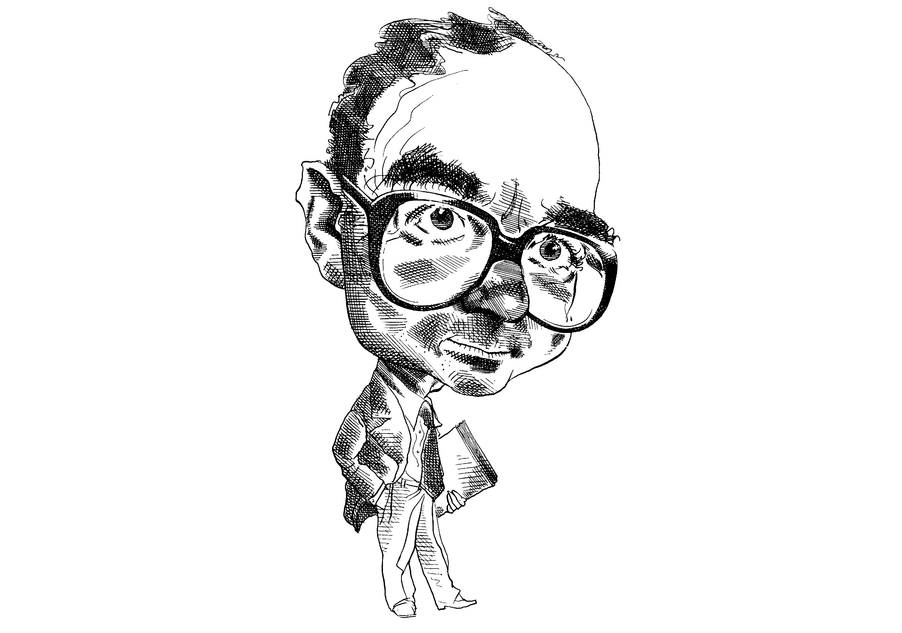
Hans-Joerg Rudloff, widely regarded as a titan of the bond market and a man who for half a century shaped global finance and several institutions around his vision, died on December 1 aged 85.
As a swashbuckling syndicate manager, he helped turn the sleepy Eurobond market into a highly profitable and core feature of the world's capital markets – one that was dominated by Credit Suisse, one of two banks he helped drive to prominence.
Born in Cologne, Germany, Rudloff lived mostly in Switzerland – and London during the week.
After studying economics at Bern University, he began his banking career at Credit Suisse in 1965 and then made a relatively unconventional move in 1968 to join US broker Kidder Peabody.
After just one year in New York he returned to Switzerland, moving to Geneva with Kidder. By the end of his stint at the US firm in 1980, he was in charge of its European bond business and had given a sign of what was to come with a landmark bond transaction in 1975 for New Zealand – the first bought deal.
Top player
Michael von Clemm, head of Financiere Credit Suisse First Boston and Rainer Gut, chairman of the Credit Suisse Group, brought Rudloff to CSFB to run the new issues business.
CSFB was already the top bond player in Europe, but within months Rudloff was reshaping the syndicate and origination desks, and quite quickly dominating the Eurobond market via bought deals.
For those of later generations, it is difficult to comprehend the difference that bought deals made to deal execution. This was real underwriting risk and provided certainty for everyone in a transaction – it was also very profitable if pricing was right.
"He changed the whole risk profile of the market," said Chris O'Malley, who ran Eurobond sales at CSFB in the 1980s.
Gone were the days of 100-strong syndicates distributing what was actually quite small amounts of risk.
"It was hopelessly inefficient. Everybody cheated and lied, everybody blamed everybody else while playing dirty tricks themselves," said O'Malley.
It was a period when the best syndicate managers had to be traders. And issuers quickly grew to love the new paradigm, realising they could put banks in price competition with each other, a feature that remains part of the market to this day.
“He was very hands on … a trader with a tremendous gut feel for the market,” said Kevin O’Neil, who worked on the CSFB syndicate desk when Rudloff joined in 1980. Notably, he was not one of the people who Rudloff quickly shoved out of the door.
O’Neil points to the achievements of a business that stayed at the top of the Eurobond league tables for much of the decade without a strong balance sheet.
Going wrong
The strategy was not without its risks. O’Neil remembers one of the trades that went wrong in the first year of Rudloff’s reign – a five-year US dollar deal for Canada’s Export Development Corporation when CSFB lost millions it could ill afford.
One transaction that went very right, on the other hand, was a convertible bond for Texaco. In March 1984, the oil major, which had bought Getty Oil for US$10.1bn, announced a 10-year convertible bond that was quickly increased to US$1bn from US$800m, making it twice the size of any other previous corporate bond at the time.
This was a Eurodollar deal, and therefore not for sale in the US market. To manage its huge size and to encourage global distribution, lead managers were organised into four syndication groups, each responsible for distributing the issue in a specific region. The deal was repeated for US$500m a few weeks later.
Market share
It was during this period the Eurobond market took off, multiplying tenfold by 1990 from US$18.5bn in 1980. In contrast to houses centred on advisory, CSFB was an avowedly capital markets-focused operation that concentrated on originating, selling and trading new issues. It brought more debut borrowers than anyone else, and at one time had a market share of almost 90% in FRNs.
According to insiders, the new issues business accounted for 60% of the revenues at CSFB by 1986.
During this period, another innovation became central to markets: the swap market. This meant that banks were managing even more risk as issuers would want to know what their all-in price of funds would be and Rudloff was quick to bring the swaps desk into his orbit.
Rudloff was aggressive in executing business strategy, happy to hire entire teams from other banks if that would give his firm a leg up in a product or sector.
In 1992 he brought in Allen Wheat from Bankers Trust to create Credit Suisse Financial Products, placing derivatives at the centre of markets trading. But while his understanding of the capital markets may have helped drive the fortunes of CSFB – the bank had taken over First Boston properly by then – ever higher, Rudloff was not a derivatives wonk and the super-sized profits (and, as it turned out, risks) that Wheat generated meant the power base was shifting.
The market was changing in other ways too. In addition to the explosion in derivatives, deals were increasingly sold via a fixed-price reoffer, which naturally limited the potential profits of bought deals.
Swashbuckling was becoming less fashionable and less relevant.
Chairman
He led CSFB for around five years as CEO and chairman before announcing his shock resignation in 1993, leaving to run a short-lived Eastern Europe-focused boutique called MC Securities. But his time in the markets was not done, although after he flipped the boutique to BBL he spent a few years on the sidelines.
Enter Bob Diamond, who after running fixed income at Morgan Stanley joined CSFB in 1992 before leaving in 1996 to run global markets at Barclays.
Upon discovering that only Gilts and sterling new issues made any money, Diamond quickly decided to jettison cash equities and M&A – selling to CSFB. The new strategy was to focus on bonds, derivatives, capital markets and foreign exchange.
"I had a cup of coffee with Hans-Joerg … and took him through the story. He looked at me, and he goes, 'Bob, it's brilliant. You're absolutely right. No other European bank has been able to succeed [in making money as an all-service investment bank], with the possible exception of CSFB, [and only] having acquired a US bulge-bracket back in First Boston'," Diamond said.
Rudloff believed in the strategy – after all it was not so different to that he had pursued at CSFB, at least initially.
“This swashbuckling 'eminence grise', father the Euromarket, came in and turned out to be such an incredible adviser to me and everyone on our executive committee,” said Diamond.
Alongside Diamond, Rudloff helped propel Barclays Capital – the investment banking unit of the UK lender – into the top ranks of global fixed income within a decade.
Rudloff announced his retirement from investment banking in 2014 after 49 years in the markets, stepping down as chairman of Barclays’ investment banking business. But he carried on, working as chairman of Marcuard Capital, the Zurich-based private bank.
Even then, he was not done with Credit Suisse and advised Diamond four years ago on an attempt to buy the by then deeply troubled bank’s investment banking operation. In the end, that was one that got away – unlike so many other deals over one of the great careers of modern banking.
Rudloff: not a man to be messed with
It was sometime in the mid-to-late 1980s when I first bumped into Hans-Joerg Rudloff – well on the telephone, at least, writes former IFR editor Simon Hylson-Smith.
I was a young reporter; he was already a legend on the CSFB trading floor and far beyond.
At the time, IFR Vigil was a service on Telerate that tracked new issues. On this occasion, like many others, we had scooped a new Eurobond issue for a European government.
Within seconds of pressing the button to publish the story, this early 20-something-year-old got a call. It wasn’t pleasant. Rudloff demanded we pull down the story. I asked if it was wrong. That didn’t help.
After a tirade that seemed to go on for an age, Rudloff threatened to cancel all IFR subscriptions across CSFB, at the time a giant in the markets.
We called his bluff. Fortunately, CSFB ended up taking out even more subscriptions and a small victory could be chalked up for journalists.
Hylson-Smith joined IFR as a reporter in 1986 before becoming editor between 1992 and 1999.